When does masseter Botox kick in?
This is one of the most common questions asked by people considering jaw Botox for jaw slimming, TMJ relief, or teeth grinding. Unlike wrinkle Botox, masseter Botox does not produce instant visible changes. Instead, it follows a gradual and medically predictable timeline as the jaw muscles slowly relax and adapt.
Masseter Botox works by reducing excessive activity in the masseter muscle, one of the strongest chewing muscles in the body. As muscle tension decreases, patients experience relief from clenching and jaw pain first, followed later by visible lower-face slimming and jawline contouring. Understanding this timeline helps set realistic expectations and prevents unnecessary concern during the early stages.
What Is Masseter Botox?
Masseter Botox is a non-surgical treatment in which botulinum toxin injections are placed into the masseter muscles on each side of the jaw. These muscles play a central role in chewing, clenching, and grinding. When overactive, they can cause jaw pain, headaches, TMJ symptoms, and a wider or square-looking jawline.
By calming excessive muscle contraction, masseter Botox helps restore balance between function and appearance without altering bone structure or facial fat.
How Masseter Botox Works in the Body
Masseter Botox works by temporarily blocking nerve signals that tell the jaw muscle to contract forcefully. Specifically, it reduces the release of acetylcholine, the neurotransmitter responsible for muscle activation. As signaling decreases, the muscle relaxes while still allowing normal chewing and speaking.
This controlled reduction in activity is what makes masseter Botox both safe and effective for therapeutic and cosmetic use.
Why Masseter Botox Does Not Work Instantly
Many people expect masseter Botox to work immediately, similar to numbing injections. In reality, botulinum toxin requires time to bind to nerve endings and interrupt chemical signaling. This biological process unfolds gradually over several days.
Because the masseter muscle is large and powerful, it takes longer to respond compared to smaller facial muscles. This delay is medically normal and does not indicate treatment failure.
When Does Masseter Botox Kick In? (Quick Answer)
Most patients notice:
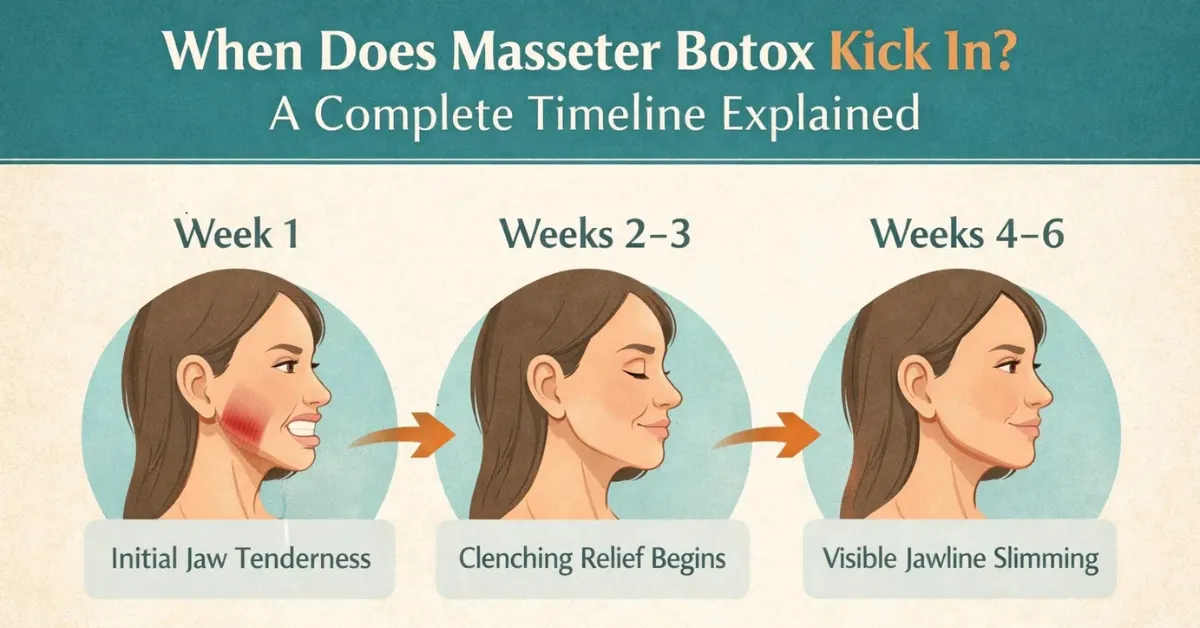
- Early functional relief: 3–7 days
- Reduced clenching and jaw tension: ~2 weeks
- Visible jaw slimming: 4–6 weeks
- Peak results: 8–12 weeks
Masseter Botox Results Timeline (Week-by-Week)
Masseter Botox Timeline
| Time After Treatment | What’s Happening |
| 1–3 days | Botox begins binding to nerve endings |
| 3–7 days | Jaw tension starts reducing |
| 2 weeks | TMJ relief and bruxism improvement |
| 4–6 weeks | Jawline softening becomes visible |
| 8–12 weeks | Peak slimming and contouring |
| 3–6 months | Effects gradually wear off |
Why Jaw Botox Feels Different Before It Looks Different
Functional improvement almost always comes first. Patients frequently report less jaw tightness, fewer headaches, and reduced clenching well before seeing visible facial changes.
This happens because muscle strength decreases before muscle size changes. True jawline slimming only occurs once the muscle begins to shrink from reduced use, which takes time.
How Muscle Atrophy Creates Jawline Slimming
Masseter Botox does not dissolve fat or reshape bone. Instead, it produces controlled muscle atrophy. When a muscle is no longer overworked, it no longer needs the same bulk to function. Over several weeks, the muscle becomes thinner, resulting in a softer, slimmer lower face.
This process is gradual, reversible, and one of the reasons masseter Botox produces natural-looking results.
Jaw Slimming Timeline: What You’ll See
Jawline Slimming Progress
| Week | Visible Change |
| Week 2 | Minimal or no visible change |
| Week 4 | Jaw angles soften |
| Week 6 | Lower face noticeably slimmer |
| Week 8–12 | Final jawline contour |
Masseter Botox for TMJ Relief: Timeline
TMJ symptom relief usually appears earlier than cosmetic changes.
TMJ Botox Relief Timeline
| Symptom | Expected Improvement |
| Jaw tension | 7–10 days |
| Headaches | 10–14 days |
| Jaw clicking | 2–4 weeks |
| Night clenching | 2–3 weeks |
Why Some People See Results Faster Than Others
Results vary based on:
- Muscle size and strength
- Botox dosage per side
- Stress levels and clenching habits
- Individual metabolism
Patients with severe clenching may feel relief quickly but see slower cosmetic change, while those with mild hypertrophy may slim sooner.
The Difference Between TMJ Relief and Cosmetic Jaw Slimming
TMJ treatment focuses on pain relief and muscle relaxation, which improves early. Cosmetic jaw slimming depends on muscle volume reduction, which takes longer.
Feeling better does not always mean looking different right away — and that is expected.
Why Conservative Dosing Produces Better Results
Higher doses do not mean faster results. Over-treatment can lead to chewing fatigue, facial imbalance, or lower-face sagging. Conservative, staged dosing preserves jaw support and delivers more predictable outcomes.
Experienced providers often reassess results after several weeks rather than injecting aggressively at the first session.
Psychological Adjustment to Gradual Facial Change
Because masseter Botox works slowly, patients often underestimate their improvement until they compare before-and-after photos. This gradual change allows the face — and the brain — to adapt naturally, reducing dissatisfaction.
Duration: How Long Do Results Last?
Masseter Botox typically lasts 3–6 months. With repeated treatments, some patients experience longer-lasting effects as the muscle becomes less overactive over time.
Post-Treatment Care Tips
- Avoid heavy chewing for 24 hours
- Do not massage the jaw area
- Stay upright for 4 hours
- Manage stress to reduce clenching
Expert Takeaway
If you are asking when does masseter Botox kick in, the most accurate answer is:
- Relief: 1–2 weeks
- Slimming: 4–6 weeks
- Peak results: 8–12 weeks
Masseter Botox is a safe, non-surgical, and well-studied option for jaw tension, TMJ relief, and facial slimming when performed correctly and patiently.
Faqs – Masseter Botox
Can masseter Botox actually cause jowls?
Are jowls from masseter Botox permanent?
Who is most at risk of developing jowls after masseter Botox?
| Risk Factor | Why It Matters |
|---|---|
| Skin laxity | Less support after muscle relaxation |
| Facial volume loss | Jowls become more visible |
| Age over 40 | Reduced collagen and elasticity |
| High Botox dose | Excess muscle weakening |
How long after masseter Botox do jowls appear?
Can masseter Botox make you look older?
How can jowls be prevented with masseter Botox?
| Strategy | Benefit |
|---|---|
| Conservative dosing | Preserves muscle support |
| Facial assessment | Identifies laxity early |
| Staged treatments | Avoids sudden contour changes |
What should I do if I notice jowls after jaw Botox?
Does TMJ Botox increase the risk of facial sagging?
Is masseter Botox safe for patients over 40?
Can fillers fix jowls caused by masseter Botox?
| Treatment | Purpose |
|---|---|
| Jawline filler | Restores contour and support |
| Chin filler | Improves lower-face balance |
| Skin tightening | Improves firmness and laxity |
References
- American Academy of Dermatology (AAD)
Authoritative guidance on Botox safety, muscle relaxation, cosmetic and therapeutic uses.
https://www.aad.org - Mayo Clinic
Medical explanations of botulinum toxin, onset time, duration, and side effects.
https://www.mayoclinic.org - Cleveland Clinic
Detailed patient education on Botox for jaw pain, TMJ disorders, and facial muscles.
https://my.clevelandclinic.org - Plastic and Reconstructive Surgery Journal
Peer-reviewed studies on masseter muscle reduction, jawline slimming, and Botox timelines.
https://journals.lww.com/plasreconsurg - Journal of Oral & Maxillofacial Surgery (JOMS)
Clinical research on TMJ Botox, jaw muscle overactivity, and therapeutic dosing.
https://www.joms.org - International Association for Dental Research (IADR)
Evidence on bruxism, jaw clenching, and chewing muscle treatments.
https://www.iadr.org - British Association of Aesthetic Plastic Surgeons (BAAPS)
Guidance on facial anatomy, aging, lower-face balance, and conservative injectable treatments.
https://baaps.org.uk