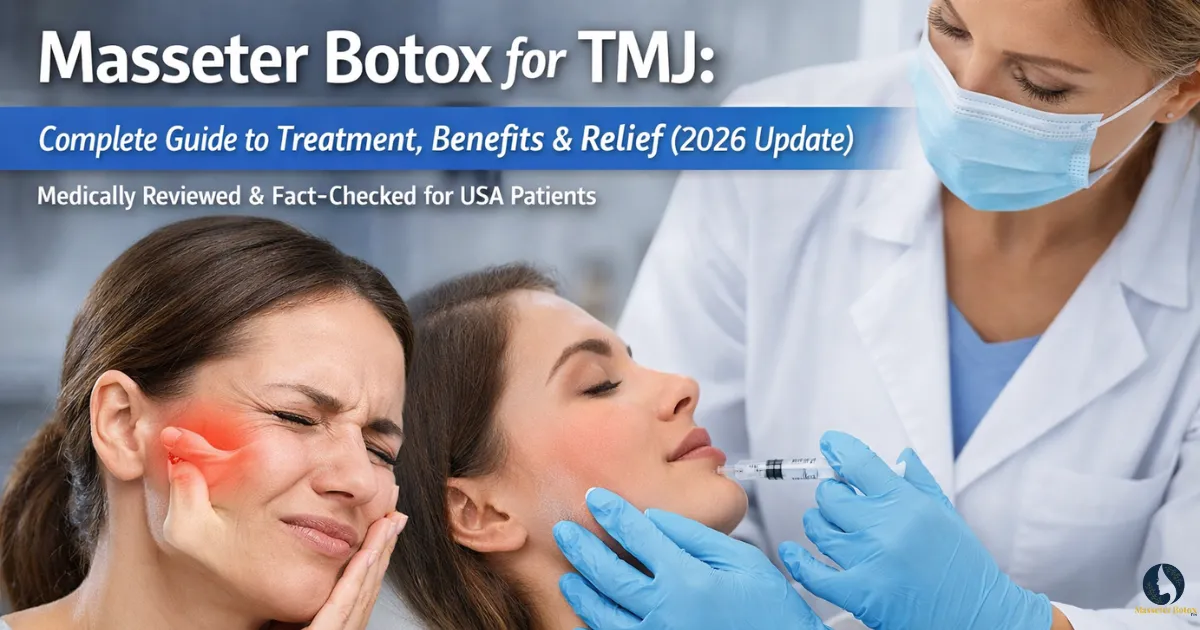
Medically Reviewed & Fact-Checked for USA Patients
If you suffer from jaw pain, clicking sounds when you eat, tension headaches, or difficulty chewing, you may be one of the millions of Americans affected by temporomandibular joint (TMJ) disorders. While traditional treatments include mouth guards, physical therapy, and pain medications, there’s a non-surgical option gaining significant attention: Masseter Botox for TMJ relief.
This comprehensive guide explains how Botox injections in the masseter muscle can provide lasting relief from TMJ symptoms, what the treatment involves, how much it costs, and what results you can expect.
Quick Takeaways: Masseter Botox for TMJ at a Glance
| Key Fact | Information |
| What It Treats | Jaw pain, teeth grinding (bruxism), tension headaches, jaw stiffness, TMJ disorders |
| How It Works | Blocks nerve signals to relax overactive jaw muscles |
| Treatment Time | 10-15 minutes |
| Relief Timeline | 1-2 weeks for tension relief; full results by 4-6 weeks |
| Duration of Results | 4-6 months |
| Typical Dosage | 20-30 units per side (40-60 total) |
| Average Cost | $400-$900 per session |
| FDA Status | Off-label use (widely practiced) |
What Is TMJ and How Does Masseter Botox Help?
Understanding TMJ Disorders
The temporomandibular joint (TMJ) connects your jawbone to your skull, acting like a sliding hinge. TMJ disorders—often called TMD—can cause significant pain and dysfunction in this joint and the surrounding muscles .
Common TMJ Symptoms:
- Jaw pain or tenderness
- Pain in one or both temporomandibular joints
- Aching facial pain
- Difficulty or pain while chewing
- Clicking, popping, or grating sounds when opening mouth
- Locking of the joint, making it hard to open or close mouth
- Tension headaches
- Earaches or pain around the ears
The Role of the Masseter Muscle
The masseter muscle is one of the strongest muscles in the body relative to its size. Located at the back of the jaw, it’s the primary muscle responsible for closing the jaw during chewing . When this muscle becomes overactive—often due to stress, grinding teeth (bruxism), or clenching—it can strain the temporomandibular joint and cause the symptoms listed above .
How Masseter Botox Provides TMJ Relief
Botox works by blocking nerve signals between the brain and the masseter muscle. When these signals are interrupted, the muscle relaxes and can no longer contract with the same force . This relaxation provides several benefits for TMJ sufferers:
| Benefit | How It Works |
| Reduced Jaw Tension | Relaxed muscles put less strain on the TMJ |
| Decreased Teeth Grinding | Less force during nighttime clenching |
| Headache Relief | Reduced muscle tension alleviates tension headaches |
| Pain Reduction | Less muscle activity means less pain |
| Protection from Dental Damage | Weakened grinding force protects teeth |
According to Dr. Emily Clarke of U.S. Dermatology Partners, “Botox has become well-known for its role in anti-aging and aesthetics, but Botox was actually initially developed for muscle disorders before its cosmetic applications were discovered. Off-label use of Botox for symptom relief and cosmetic improvement may be a helpful adjunctive treatment for TMD and masseter enlargement” .
Scientific Evidence: Does Masseter Botox Really Work for TMJ?
Research supports the use of botulinum toxin for TMJ disorders. Studies have shown:
- Significant pain reduction in patients with TMJ disorders after Botox injections
- Decreased bite force by up to 80%, reducing damage from grinding
- Improved jaw function and range of motion
- Reduced frequency of tension headaches associated with jaw clenching
A 2022 study published in Life examined the effects of Botox on the masseter muscle and found that treatment not only reduced muscle activity but also affected surrounding muscles of mastication, highlighting the importance of proper technique and dosage .
Masseter Botox for TMJ: Who Is the Ideal Candidate?
Good Candidates Include Those Who:
| Criterion | Description |
| Diagnosed with TMJ or bruxism | Confirmed by dentist or healthcare provider |
| Experience chronic jaw pain | Daily or frequent discomfort |
| Have tension headaches | Especially those originating from jaw tension |
| Grind or clench teeth | Nighttime grinding or daytime clenching |
| Have not responded to traditional treatments | Night guards, physical therapy, or medications haven’t provided sufficient relief |
Who Should Avoid Masseter Botox for TMJ?
Masseter Botox may not be recommended for those who are:
- Pregnant or breastfeeding
- Allergic to botulinum toxin or any ingredients
- Dealing with active skin infections at injection sites
- Suffering from neuromuscular disorders
- Taking certain medications that may interact (consult your provider)
The Masseter Botox Treatment Process for TMJ
Step 1: Consultation and Evaluation
Your journey begins with a thorough consultation with a qualified provider—ideally a board-certified dermatologist, plastic surgeon, or dentist experienced in TMJ treatments . During this visit, the provider will:
- Evaluate your jaw muscle size through palpation
- Discuss your TMJ symptoms and medical history
- Examine your bite pattern
- Determine appropriate dosage based on muscle thickness and symptom severity
- Explain the risks, benefits, and expected outcomes
Step 2: Treatment Day
The actual procedure is quick and minimally invasive:
| Step | What Happens |
| Preparation | Treatment area is cleansed with alcohol |
| Injection | 3-5 injections per side into the masseter muscle |
| Technique | May be injected while you clench to ensure accurate placement |
| Duration | 10-15 minutes total |
| Discomfort | Minimal—described as small pinches |
No anesthesia is required, though some providers may use ice or numbing cream for additional comfort.
Step 3: Aftercare Instructions
Proper aftercare ensures optimal results and minimizes complications:
First 4 Hours:
- Remain upright; do not lie down
- Avoid touching or rubbing the area
First 24 Hours:
- No strenuous exercise
- No alcohol consumption
- No massage or pressure on the jaw
- Avoid hot baths, saunas, or excessive heat
Days 2-7:
- Gentle chewing encouraged to help Botox bind to receptors
- Can resume normal activities immediately
- Apply ice for any swelling
Masseter Botox for TMJ: Results Timeline
Understanding when to expect relief helps set realistic expectations.
| Timeframe | What to Expect |
| Days 1-3 | Mild soreness at injection sites; no noticeable changes yet |
| Week 1 | Initial reduction in jaw tension; grinding force begins to decrease |
| Weeks 2-4 | Significant relief from TMJ pain and tension headaches |
| Weeks 4-6 | Full therapeutic effect achieved; maximum pain relief |
| Months 3-4 | Results begin to gradually fade |
| Months 4-6 | Muscle function returns; retreatment needed to maintain relief |
How Long Does Relief Last?
For TMJ and bruxism symptoms, most patients experience relief for 3 to 5 months . Functional symptoms like jaw tension and morning headaches often return before visible changes, making symptom tracking essential for optimal timing.
Masseter Botox for TMJ: Dosage and Cost
Typical Dosage for TMJ Relief
The masseter muscles are the strongest in the face, requiring higher than normal dosages of Botox .
| Patient Type | Units Per Side | Total Units |
| Women (average) | 20-25 units | 40-50 units |
| Men (average) | 25-40 units | 50-80 units |
| Severe bruxism | 30-35 units | 60-70 units |
| First-time patients | 20-25 units | 40-50 units |
Masseter Botox Cost for TMJ Treatment
The cost of masseter Botox for TMJ typically ranges from $400 to $900 per treatment session . With Botox priced at $10-$15 per unit, most patients require 40-60 total units for optimal therapeutic results .
Factors Affecting Cost:
- Geographic location – Prices higher in major metropolitan areas
- Provider expertise – Board-certified specialists charge more
- Number of units required – Based on muscle strength and symptom severity
- The type of neurotoxin used – Botox, Dysport, Xeomin, etc.
Is It Covered by Insurance?
Generally no, masseter Botox for TMJ is considered an off-label cosmetic procedure. However, if you have documented medical necessity for severe bruxism or TMJ disorders, you may be able to use HSA or FSA funds . Some patients successfully submit claims to insurance, but reimbursement is rare. Check with your provider and insurance company before treatment.
Masseter Botox vs. Traditional TMJ Treatments
| Treatment Option | How It Works | Average Cost | Duration | Pros | Cons |
| Masseter Botox | Relaxes jaw muscles | $400-$900/session | 4-6 months | Non-invasive, fast, treats cause directly | Temporary, not always covered |
| Custom Night Guard | Prevents teeth contact | $300-$800 | 1-5 years | Protects teeth, insurance may cover | Doesn’t stop grinding, only protects |
| Physical Therapy | Strengthens and stretches jaw muscles | $100-$300/session | Variable | Addresses underlying issues | Time-intensive, multiple sessions |
| Pain Medications | Reduces pain temporarily | $10-$100/month | Temporary | Easy access | Doesn’t treat cause, side effects |
| TMJ Surgery | Reconstructs or replaces joint | $5,000-$50,000 | Permanent | Permanent solution | Invasive, risks, long recovery |
Masseter Botox for TMJ: The Dual Benefit
One of the most appealing aspects of masseter Botox for TMJ is the dual benefit it provides: pain relief PLUS aesthetic improvement.
Medical Benefit: TMJ Symptom Relief
TMD refers to issues affecting the TMJ and muscles that connect your jawbone to the skull. When caused by chronic grinding or clenching, Botox can:
- Reduce jaw pain and stiffness
- Decrease headache frequency
- Minimize earaches and facial pain
- Improve chewing comfort
According to Belgravia Dermatology, “Masseter pain can be a symptom of temporomandibular joint dysfunction (TMJD) and tension type headaches. Botox into the masseters has been shown to reduce pain levels significantly in these instances” .
Cosmetic Benefit: Slimmer Jawline
Continual or chronic jaw movements caused by bruxism lead to a bulkier masseter muscle, creating a square-shaped jawline . As a bonus of TMJ treatment, patients often enjoy:
- A softer, more tapered jawline
- A V-shaped facial contour
- Enhanced cheekbone prominence
- More balanced facial proportions
Dr. Clarke notes, “Not only can Botox reduce jaw pain and stiffness related to TMD in some patients, but it also has the added benefit of slimming the jawline, especially when the masseter muscle has enlarged from chronic overuse” .
Potential Side Effects and Risks
While generally safe when performed by experienced practitioners, potential complications include :
| Side Effect | Description | Frequency |
| Temporary muscle weakness | Difficulty chewing tough foods | Common with higher doses |
| Crooked smile | Asymmetrical smile from toxin spread to risorius muscle | Occasional |
| Facial asymmetry | Uneven results between left and right sides | Occasional |
| Bruising | Minor bleeding at injection sites | Most common minor side effect |
| Paradoxical bulging | Unexpected muscle protrusion when clenching | Rare with proper technique |
| Allergic reactions | Rash, itching, or difficulty breathing | Extremely rare |
Important Safety Considerations
Masseter Botox for TMJ is an off-label use—the FDA hasn’t specifically approved Botox for masseter muscle reduction or TMJ treatment . However, it’s widely practiced by qualified professionals with excellent safety records.
Always choose a qualified practitioner experienced in facial anatomy and TMJ treatment. Dermatologists and plastic surgeons have the knowledge and qualifications necessary to provide this off-label treatment safely and effectively .
How to Choose a Provider for TMJ Masseter Botox
Qualifications to Look For
| Provider Type | Why Choose |
| Board-Certified Dermatologist | Expertise in facial anatomy and injectables |
| Board-Certified Plastic Surgeon | Comprehensive understanding of facial structure |
| Oral and Maxillofacial Surgeon | Specialized knowledge of jaw anatomy |
| Cosmetic Dentist with TMJ training | Understanding of bite mechanics and TMJ disorders |
Questions to Ask Before Booking
- How many masseter Botox treatments have you performed for TMJ patients?
- Can I see before and after photos of your TMJ patients?
- Do you use ultrasound or EMG guidance for precise placement?
- What is your approach to determining dosage for TMJ relief?
- What happens if I need a touch-up?
- What is your policy if I develop complications?
Red Flags to Avoid
- Prices significantly below market average
- Inability to show before and after photos
- Non-medical personnel performing injections
- Pressure to book immediately
- No consultation before treatment
- Unwillingness to discuss risks
Summary: Masseter Botox for TMJ Quick Reference
| Category | Key Information |
| Primary Benefit | Reduces jaw pain, tension headaches, teeth grinding |
| Secondary Benefit | Slims jawline, creates V-shaped facial contour |
| Treatment Time | 10-15 minutes |
| Relief Onset | 1-2 weeks |
| Full Results | 4-6 weeks |
| Duration | 3-5 months |
| Typical Dosage | 20-30 units per side (40-60 total) |
| Average Cost | $400-$900 per session |
| Insurance Coverage | Rare; HSA/FSA may apply |
| Best For | TMJ pain, bruxism, tension headaches, jaw clenching |
Conclusion: Is Masseter Botox Right for Your TMJ?
Masseter Botox offers a promising, non-surgical option for those suffering from TMJ disorders, teeth grinding, and chronic jaw tension. With its dual benefit of pain relief and aesthetic improvement, it’s no wonder this treatment has gained popularity among patients seeking relief from debilitating jaw symptoms.
The key takeaways:
- It works – Clinical evidence supports significant pain reduction for TMJ sufferers
- It’s safe – Complications are rare (0.48%) and always temporary
- It’s convenient – 15-minute procedure with no downtime
- It requires maintenance – Results last 3-5 months, requiring repeat treatments
- Provider selection matters most – Choose board-certified professionals with TMJ experience
If you’re tired of living with jaw pain, tension headaches, or damaged teeth from grinding, schedule a consultation with a qualified provider to discuss whether masseter Botox for TMJ could be your path to relief.
Frequently Asked Questions About Masseter Botox for TMJ
Does Botox really help with TMJ?
Yes. Botox has been shown to significantly reduce pain levels associated with TMJ disorders by relaxing overactive jaw muscles. It blocks nerve signals that cause excessive muscle contractions, providing relief from jaw tension, headaches, and discomfort.
How long does masseter Botox last for TMJ?
For TMJ and bruxism symptoms, relief typically lasts 3 to 5 months. Functional symptoms like jaw tension and morning headaches often return before visible changes, making symptom tracking essential for optimal timing.
How many units of Botox are needed for TMJ?
Most patients require 20-30 units per side (40-60 total units) for therapeutic TMJ relief. Men typically need more, often 25-40 units per side due to larger muscle mass. Severe teeth grinding cases may also require higher doses.
Is masseter Botox for TMJ covered by insurance?
Generally no, it’s considered an off-label cosmetic procedure. However, if you have documented medical necessity for severe bruxism or TMJ disorders, you may be able to use HSA or FSA funds. Some patients successfully submit claims to insurance, but reimbursement is rare.
Can masseter Botox make TMJ worse?
No, when properly administered by a qualified provider, Botox should not worsen TMJ symptoms. However, incorrect placement or dosage could lead to complications like smile asymmetry or chewing difficulty. Always choose an experienced practitioner.
How soon will I feel relief from TMJ pain?
Most patients notice reduced jaw tension within the first week, with significant relief from TMJ pain and tension headaches by 2-4 weeks post-treatment.
Can I combine masseter Botox with other TMJ treatments?
Yes, masseter Botox can be used as an adjunct to other conservative TMJ treatments including oral appliances, physical therapy, and stress reduction techniques.
Will masseter Botox affect my ability to chew?
Only excessive force—normal chewing of food remains unaffected. You may find it slightly harder to chew very tough foods like steak or bagels for the first few weeks, which is actually a sign the treatment is working.
How often do I need masseter Botox for TMJ maintenance?
For ongoing TMJ relief, most patients need treatment every 3 to 5 months. Functional symptoms often guide retiming—schedule your next appointment before jaw tension returns.
Is masseter Botox safe for long-term TMJ management?
Yes, with proper treatment by qualified providers, masseter Botox is safe for long-term use. Studies confirm that all adverse events are temporary, and muscle function returns completely once treatment is discontinued.
Can masseter Botox help with teeth grinding?
Yes, it is highly effective for bruxism. By relaxing the masseter muscle, it reduces the force of grinding by up to 80%, protecting teeth from wear and reducing morning jaw pain and headaches.
What’s the difference between masseter Botox and TMJ surgery?
Botox is non-permanent, costs $400-$900, has no downtime, and lasts 4-6 months. TMJ surgery is permanent, costs $5,000-$50,000, requires significant recovery, and carries surgical risks. Botox is far less invasive and a reasonable first-line treatment before considering surgery.