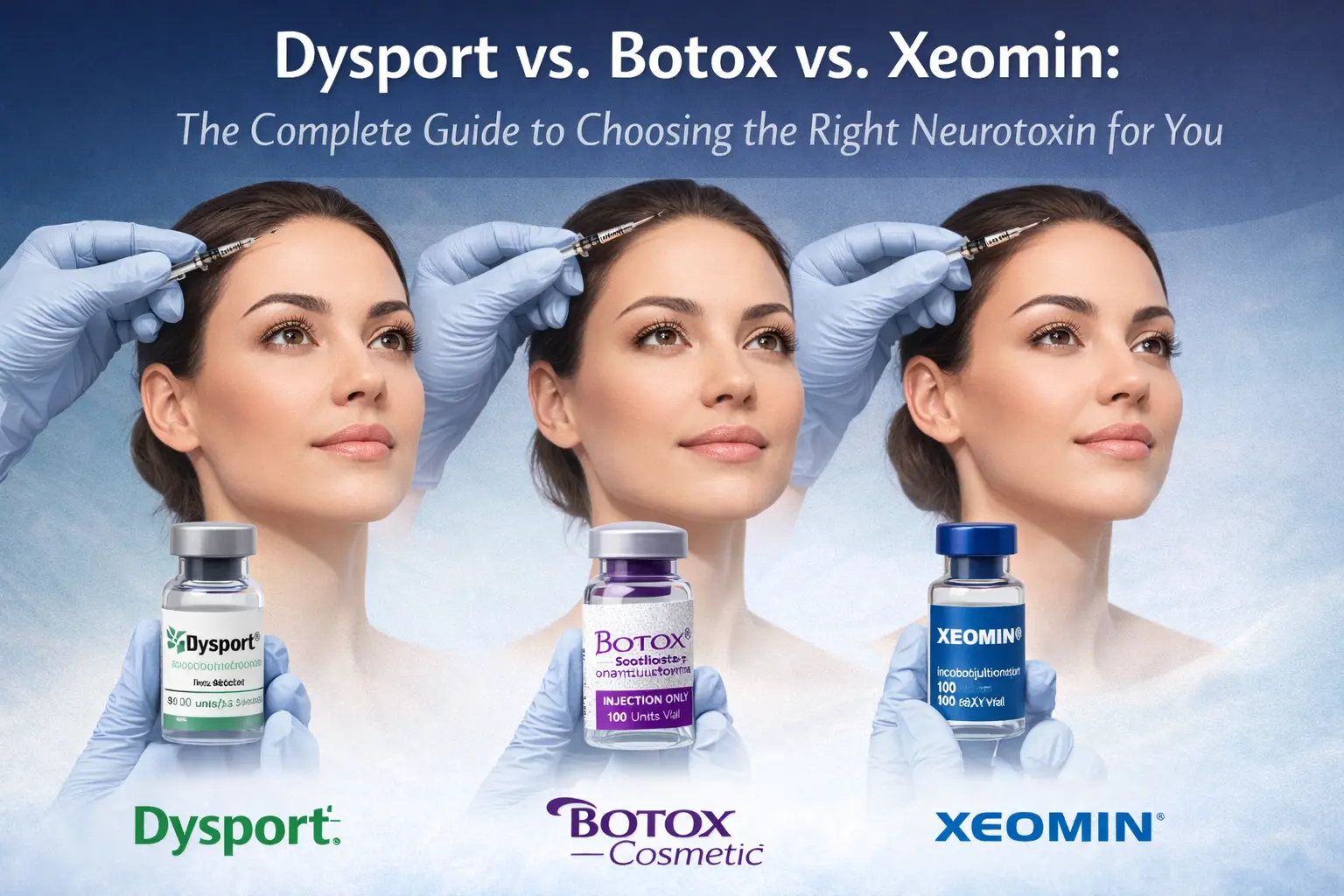
In real time medical aesthetics, neuromodulators have revolutionized how we approach aging. For decades, the term “Botox” was synonymous with wrinkle relaxation, much like “Kleenex” is for tissues . However, the landscape has expanded significantly. Today, consumers have a choice between several high-quality injectables, including Botox Cosmetic, Dysport, and Xeomin.
What Are Neuromodulators? Understanding the Basics
Before diving into the differences, it is essential to understand what these products are and how they work. Botox, Dysport, and Xeomin are all brands of botulinum toxin type A, a purified protein that acts as a neuromodulator .
How They Work
When injected into specific muscles, these products temporarily block nerve signals that tell those muscles to contract. By relaxing the underlying muscles, the skin above smooths out, reducing the appearance of dynamic wrinkles—those caused by repetitive facial expressions like frowning, squinting, or raising your eyebrows .
Common Treatment Areas
- Forehead lines: Horizontal lines across the forehead
- Glabellar lines: Vertical “11” lines between the eyebrows
- Crow’s feet: Lines at the outer corners of the eyes
- Bunny lines: Wrinkles on the nose
- Chin dimpling: Orange peel texture on the chin
- Masseter reduction: Jawline slimming and TMJ relief
- Lip flip: Enhancing the upper lip appearance
- Neck bands: Platysmal bands in the neck
The Contenders: An Overview of Each Product
To make an informed decision, it helps to understand the unique characteristics of each brand.
Botox Cosmetic: The Gold Standard
Botox (produced by Allergan) is the original FDA-approved neuromodulator, having been used cosmetically since 2002 . It has the longest track record and the most extensive clinical research backing its safety and efficacy .
- Formulation: Botox contains botulinum toxin type A along with accessory proteins (complexing proteins) that surround the core molecule .
- Reputation: It is widely considered the most predictable and reliable option, making it a favorite for precise, targeted treatments .
Dysport: The Fast Spreader
Dysport (produced by Ipsen) is known for its unique molecular structure. It has smaller molecules that allow it to diffuse or spread more easily once injected .
- Formulation: Like Botox, Dysport contains complexing proteins, though perhaps in a different configuration .
- Reputation: It is often the go-to choice for treating larger areas due to its diffusion characteristics and faster onset of action .
Xeomin: The “Naked” Neurotoxin
Xeomin (produced by Merz Pharmaceuticals) is often called the “naked” neuromodulator. During its manufacturing process, the accessory proteins are removed, leaving only the pure botulinum toxin type A .
- Formulation: It contains no additive proteins, which is a key differentiator.
- Reputation: Because of its purity, Xeomin is an excellent option for patients who may have developed resistance to other neurotoxins or those seeking a product with a lower risk of immunogenicity .
Key Differences at a Glance
To help visualize the differences, here is a comparison table based on expert insights .
| Feature | Botox | Dysport | Xeomin |
| Formulation | Contains complexing proteins | Contains complexing proteins | “Naked” – No accessory proteins |
| Onset of Results | 3–5 days | 2–3 days (Fastest) | 4–7 days |
| Peak Results | 10–14 days | 7–10 days | 10–14 days |
| Duration | 3–4 months | 3–4 months | 3–6 months (variable) |
| Spread (Diffusion) | Low / Precise | High / Broader | Balanced |
| Unit Comparison | Standard unit | Requires ~2.5-3x units vs. Botox | 1:1 ratio with Botox |
| Best For | Small, targeted areas (crow’s feet, frown lines) | Large areas (forehead) | Patients new to toxins or with resistance concerns |
Detailed Comparison: Making the Right Choice
Choosing between these three options involves looking at several factors. Here is a deeper dive into what sets them apart.
1. Formulation and Purity (Immunogenicity)
One of the most significant medical differences lies in the formulation.
- Botox and Dysport contain complexing proteins around the botulinum toxin. For the vast majority of patients, this is not an issue. However, in rare cases, the body’s immune system can develop antibodies to these proteins over time, potentially making the treatment less effective .
- Xeomin’s “naked” formulation means it lacks these accessory proteins. This purity significantly reduces the risk of developing neutralizing antibodies, making it a great choice for long-term users or those who have noticed their Botox or Dysport results fading faster than they used to .
2. Onset of Action: Which Works Fastest?
If you are preparing for a big event and need quick results, onset time matters.
- Dysport is widely recognized as the fastest-acting of the three. Patients often see visible improvement within 24 to 48 hours, with full effects settling in by day 7 to 10 .
- Botox typically takes 3 to 5 days to start working, with final results visible around the two-week mark .
- Xeomin may take slightly longer, usually 4 to 7 days to show initial effects .
3. Diffusion and Precision
This refers to how far the product spreads from the injection site.
- Dysport has a higher diffusion rate. This means it spreads more, which is advantageous for treating broad, flat areas like the forehead, where you want even coverage with fewer injection points .
- Botox is known for its precision. It stays more localized, making it the preferred choice for smaller, intricate areas like the crow’s feet around the eyes, where you want to avoid affecting nearby muscles .
- Xeomin offers a balanced diffusion profile, making it versatile for both small and medium areas .
4. Duration of Results
How long will your results last? This is a top question for any patient.
- Generally, all three products last between 3 to 4 months. However, individual metabolism, muscle strength, and dosage play significant roles .
- Some sources suggest that Xeomin can last up to 6 months for some patients, though this can vary . The longevity of Dysport and Botox is very consistent, typically falling within the 3-4 month window .
5. Dosing and Cost Analysis
This is where things can get confusing. Units are not interchangeable between brands .
- Unit Ratio: 1 unit of Botox is roughly equivalent to 1 unit of Xeomin. However, 1 unit of Botox is approximately equal to 2.5 to 3 units of Dysport . This is why you will need a higher number of Dysport units for the same area.
- Cost Per Unit: Because Dysport requires more units, the cost per unit is typically lower ($4–$6) compared to Botox ($12–$17) and Xeomin ($10–$15) .
- Total Cost: The total price of a treatment session often ends up being similar between the three, as the higher unit count of Dysport balances out its lower per-unit price. Always ask your provider for the total cost of treatment, not just the cost per unit .
To learn more about pricing for other injectable treatments, you can read our guide on understanding the costs of dermal fillers.
Choosing the Right Product for Specific Areas
Different areas of the face have different needs. Here is how these neurotoxins stack up for specific concerns.
For the Forehead (Frontalis Muscle)
- Winner: Dysport. The forehead is a broad, sheet-like muscle. Dysport’s ability to diffuse evenly makes it ideal for creating a smooth, natural look across the forehead without the risk of leaving isolated “ridges” of movement .
- Alternatives: Botox and Xeomin are also highly effective in the forehead when placed strategically by an experienced injector.
For Frown Lines (Glabellar Complex/”11″ Lines)
- Winner: Personal Preference. All three are FDA-approved for this area.
- Botox is the classic choice for its precision in targeting the specific muscles that pull the brows together .
- Daxxify (a newer, longer-lasting option) is noted for its potency in this area for patients with very strong muscles .
- Xeomin is excellent here, especially for first-timers .
For Crow’s Feet (Lateral Canthal Lines)
- Winner: Botox or Xeomin. This area requires a high degree of precision to avoid affecting the muscles that control your smile or lower eyelid. The more targeted nature of Botox and Xeomin makes them preferred choices for this delicate area . Dysport can be used, but it requires a highly skilled injector to prevent migration.
For Masseter Reduction (Jawline Slimming)
All three products can be used for masseter Botox to slim the jawline and treat bruxism. However, the dosing differs significantly due to the unit conversion.
- As noted by the American Society of Plastic Surgeons, you may need about 30-60 units of Botox/Xeomin per side, or 84-168 units of Dysport per side to achieve visible results in the masseter muscle .
If you are specifically interested in this treatment, read our detailed article on what does masseter Botox do.
Potential Side Effects and Safety
All three neuromodulators have an excellent safety profile when administered by a qualified professional . Common, temporary side effects include :
- Bruising, swelling, or redness at the injection site
- Mild headache
Rare Side Effects
Rare complications can occur, often related to incorrect injection technique. These include:
- Ptosis (drooping eyelid): If the toxin migrates to the wrong muscle.
- Crooked smile or asymmetry: If the product affects muscles not intended for treatment.
- Difficulty swallowing: In very rare cases, usually associated with high doses for cervical dystonia, not standard cosmetic use.
Reducing Risks
To minimize risks, it is vital to follow proper aftercare instructions, such as staying upright for 4 hours and not rubbing the treated area . Most importantly, always choose a board-certified dermatologist or plastic surgeon with extensive experience in injectables .
Conclusion
In the debate of Dysport vs. Botox vs. Xeomin, there is no single “best” product—only the best product for you. Your choice should be guided by your treatment area, desired onset time, budget, and medical history.
- Choose Botox for precision and a time-tested, predictable result, especially in small areas.
- Choose Dysport for a faster onset and excellent coverage over large areas like the forehead.
- Choose Xeomin for its pure formulation, making it ideal for those concerned about resistance or trying a neuromodulator for the first time.
Ultimately, the most critical factor in your satisfaction is not the brand name, but the expertise of the person holding the syringe. A consultation with a qualified medical professional will ensure you receive a customized treatment plan that enhances your natural beauty while maintaining your unique facial expressions.
If you are ready to take the next step, contact our clinic today to schedule a consultation. We will help you navigate these options and create a personalized plan to help you look and feel your best.
Frequently Asked Questions
Which lasts longer, Botox, Dysport, or Xeomin?
All three typically last 3 to 4 months. Some patients report Xeomin lasting slightly longer (up to 6 months in some cases), but this is highly individual.
Can I switch between brands?
Yes. In fact, switching to Xeomin is often recommended if you feel you have built up a resistance to Botox or Dysport.
Which is better for beginners?
Xeomin is often cited as a great option for first-timers due to its purity and lower risk of immunogenicity. However, an experienced injector will choose the best product based on your anatomy.
Does Dysport spread more than Botox?
Yes, Dysport has a higher rate of diffusion, which is why it is excellent for the forehead.
Why does Dysport require more units?
The units are simply measured differently. 1 unit of Botox is not the same as 1 unit of Dysport. The conversion is roughly 1:2.5 or 1:3.
Which product is the most natural-looking?
All three can look natural when injected correctly. The key is the injector’s skill in using the right amount of product to soften lines without causing a “frozen” look.
Can these treatments prevent wrinkles?
Yes. By relaxing the muscles that cause dynamic wrinkles, regular use can prevent those lines from etching themselves into the skin permanently.
Is there a risk of building a tolerance?
There is a small risk with products containing complexing proteins (Botox, Dysport). This is why Xeomin’s naked formulation is a valuable alternative for long-term patients.
Which is better for excessive sweating (hyperhidrosis)?
Botox and Dysport are both FDA-approved for treating underarm hyperhidrosis. Xeomin is also used off-label for this purpose with great success.
How do I find a qualified injector?
Look for a board-certified plastic surgeon or dermatologist. Don’t be afraid to ask about their experience, request to see before-and-after photos, and ensure they take the time to understand your goals.