Millions of people around the world choose Botox every year. It ranks as one of the most popular non-surgical cosmetic procedures on the planet. Yet most people still wonder — how does Botox actually work inside your body?
Whether you want smoother skin, relief from migraines, or treatment for excessive sweating, this guide explains everything clearly. You will learn the science, the process, the benefits, the risks, and exactly what to expect at every step.
Let us start with the basics and build your knowledge from the ground up.
What Is Botox? Understanding the Basics
Botox is a brand name for a purified protein called botulinum toxin. Doctors and scientists produce it from the bacterium Clostridium botulinum. Although this bacterium produces a powerful toxin in large amounts, medical-grade Botox uses an extremely tiny, safe, controlled dose.
The FDA approved Botox for cosmetic use in 2002. Since then, dermatologists and plastic surgeons have used it to treat both aesthetic and medical conditions with proven, consistent results.
Key facts about Botox at a glance:
- Botox comes from botulinum toxin type A
- It is a prescription-only medical treatment
- A trained healthcare provider must administer it
- Results are temporary, lasting 3 to 6 months
- It works by relaxing targeted muscles or blocking nerve signals
How Does Botox Work? The Science Behind It
Here is where it gets fascinating. Your muscles move because your brain sends electrical signals through nerves. When a nerve signal reaches a muscle, it releases a chemical called acetylcholine at the neuromuscular junction. Acetylcholine acts like a messenger — it tells the muscle to contract.
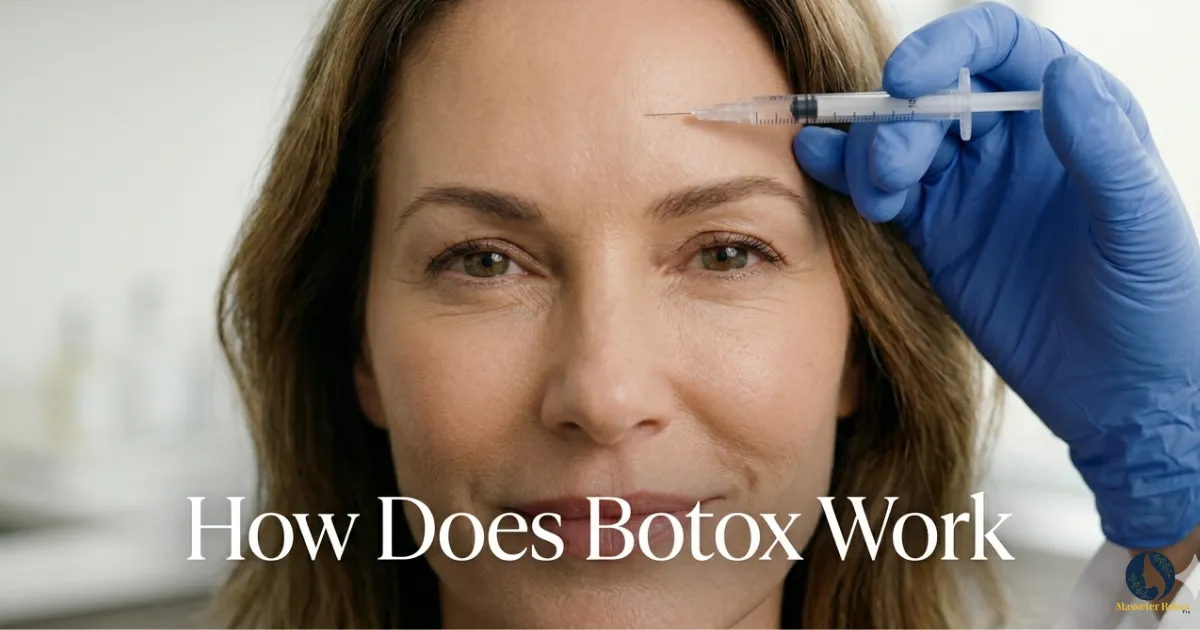
Botox blocks this process completely. When a doctor injects botulinum toxin into a muscle, it prevents the nerve endings from releasing acetylcholine. No acetylcholine means the muscle cannot receive the signal to contract. The result is a temporary, controlled muscle relaxation.
The step-by-step process works like this:
- Step 1: The doctor injects a small amount of Botox into the target area
- Step 2: Botulinum toxin binds to the nerve endings near the injection site
- Step 3: The toxin blocks acetylcholine release at the neuromuscular junction
- Step 4: The targeted muscle relaxes because it cannot receive contraction signals
- Step 5: Skin above the relaxed muscle smooths out, reducing wrinkles and lines
- Step 6: After 3 to 6 months, the nerve endings regenerate and muscle movement returns
This mechanism is precise and localized. Botox only affects the specific muscles the doctor injects. It does not spread throughout the body or affect your thinking, movement, or other functions when administered correctly.
What Does Botox Treat? Cosmetic and Medical Uses
Most people associate Botox with wrinkle reduction, but its applications go far beyond aesthetics. Doctors now use Botox to treat a wide range of medical conditions. Here is a full breakdown:
Cosmetic Uses of Botox
- Forehead lines and horizontal creases
- Frown lines between the eyebrows (glabellar lines)
- Crow’s feet around the outer corners of the eyes
- Bunny lines on the nose
- Lip lines and lip flip procedure
- Neck bands and platysmal bands
- Brow lift for a subtle eyebrow elevation
- Chin dimpling and jaw slimming (masseter reduction)
Medical Uses of Botox
- Chronic migraines (FDA-approved for adults with 15+ headache days per month)
- Hyperhidrosis (excessive sweating in the underarms, palms, or feet)
- Overactive bladder and urinary incontinence
- Cervical dystonia (involuntary neck muscle contractions)
- Blepharospasm (uncontrolled eye blinking)
- Strabismus (crossed eyes)
- Spasticity in the arms and legs after stroke
- Temporomandibular joint (TMJ) disorders and teeth grinding (bruxism)
What to Expect During a Botox Procedure
Many people feel nervous before their first Botox treatment. Knowing what happens during the procedure removes that anxiety. The process is straightforward, quick, and comfortable for most patients.
Before the Treatment
- Your provider conducts a thorough consultation to discuss your goals
- You review your medical history and current medications
- The provider examines your facial muscles and marks the injection sites
- You may apply a topical numbing cream 20 to 30 minutes before injections
- Avoid alcohol, blood thinners, and anti-inflammatory medications for one week prior
During the Treatment
- The entire procedure takes only 10 to 20 minutes
- The doctor uses an ultra-fine needle to inject small amounts of Botox
- Most patients feel only a mild pinching or stinging sensation
- No anesthesia is required — this is a walk-in, walk-out treatment
- The number of injections varies based on the treatment area and your goals
After the Treatment
- You can return to your normal daily activities immediately
- Mild redness, swelling, or bruising at injection sites may occur for 24 to 48 hours
- Avoid rubbing the treated area for at least 4 hours
- Stay upright for 4 hours post-treatment — do not lie down
- Avoid strenuous exercise and heat exposure for 24 hours
- Results appear gradually within 3 to 7 days and peak at 2 weeks
How Long Does Botox Last?
Botox results are temporary. This is a fact you must understand before your treatment. The effects typically last between 3 and 6 months, depending on several factors.
Factors that affect how long Botox lasts:
- Metabolism rate — faster metabolism breaks down Botox more quickly
- Muscle activity — highly active muscles may metabolize Botox faster
- Dosage — higher doses generally produce longer-lasting results
- Treatment area — some areas hold results longer than others
- Your age and skin condition
- Experience of the injector — technique directly impacts longevity
Regular Botox treatments train the muscles over time. Many experienced patients report that consistent treatments lead to longer-lasting results because repeated muscle relaxation reduces the strength of those muscles gradually.
Benefits of Botox Treatment
Botox offers a long list of proven benefits that explain its worldwide popularity. Here are the top reasons patients choose this treatment:
- Non-surgical — no incisions, no scars, no general anesthesia
- Quick procedure — most sessions take under 20 minutes
- Minimal downtime — patients resume daily activities immediately
- Predictable results — well-studied with decades of clinical data
- Dual purpose — treats both cosmetic concerns and medical conditions
- Customizable — providers tailor the dose and placement to your exact needs
- Boosts confidence — many patients report improved self-esteem
- Preventive value — early Botox can slow the formation of deep wrinkles
- Safe for long-term use — no evidence of harm with repeated, properly administered treatments
Botox Side Effects and Risks: What You Should Know
Botox is very safe when a trained medical professional administers it correctly. However, like any medical treatment, it carries some potential side effects. Knowing these risks helps you make an informed decision.
Common Side Effects (Usually Mild and Temporary)
- Redness, bruising, or swelling at the injection site
- Mild headache in the first 24 hours
- Temporary drooping of the eyelid or eyebrow (ptosis) — rare
- Dry eyes or excessive tearing
- Mild nausea after treatment
Rare but Serious Risks
- Botulism-like symptoms if the toxin spreads beyond the injection site (extremely rare)
- Allergic reaction — seek immediate medical help if you experience difficulty breathing
- Asymmetrical results if injections are uneven
- Infection at the injection site (rare when proper hygiene protocols apply)
Important: Always choose a board-certified dermatologist, plastic surgeon, or trained nurse injector. Avoid unqualified providers offering discounted Botox in non-medical settings. Your safety depends on the skill and training of the person performing the injection.
Who Is a Good Candidate for Botox?
Botox works well for a broad range of patients, but it is not right for everyone. Here is a quick guide to help you determine if you qualify:
Good candidates include:
- Adults aged 18 and above
- People with dynamic wrinkles caused by repeated facial expressions
- Those seeking non-surgical anti-aging treatment
- Patients with specific medical conditions such as migraines or hyperhidrosis
- Individuals in good general health with realistic expectations
Botox may NOT be suitable if you:
- Are pregnant or breastfeeding
- Have a neuromuscular disorder such as myasthenia gravis or ALS
- Are allergic to botulinum toxin or any ingredient in the formulation
- Currently take blood thinners or certain antibiotics without medical guidance
- Have an active skin infection at the planned injection site
How Much Does Botox Cost?
Botox cost varies based on several factors. Providers charge either per unit or per treatment area. Understanding the pricing structure helps you budget accurately.
- Per-unit pricing: $10 to $25 per unit on average in the United States
- Forehead lines: 10 to 30 units required ($100 to $750)
- Frown lines (glabella): 15 to 25 units ($150 to $625)
- Crow’s feet: 10 to 15 units per side ($200 to $750 total)
- Hyperhidrosis treatment: $1,000 or more per session (may have insurance coverage)
- Migraine treatment: Often covered partially or fully by health insurance
Always prioritize quality and safety over the lowest price. A cheap Botox treatment from an unqualified provider can lead to serious complications that cost far more to correct.
Botox vs. Fillers: Understanding the Difference
People often confuse Botox with dermal fillers. Both are injectable treatments, but they work in completely different ways and treat different concerns.
| Feature | Botox | Dermal Fillers |
| How it works | Relaxes muscles by blocking nerve signals | Adds volume by filling space under the skin |
| Best for | Dynamic wrinkles from muscle movement | Static wrinkles, volume loss, lip enhancement |
| Key areas | Forehead, frown lines, crow’s feet | Cheeks, lips, nasolabial folds, under-eyes |
| Duration | 3 to 6 months | 6 months to 2 years+ |
| Onset of results | 3 to 7 days | Immediate |
| Reversible | Naturally wears off | Some fillers reversible with hyaluronidase |
Final Thoughts: Is Botox Right for You?
Botox works by blocking the nerve signals that cause muscles to contract. This simple but powerful mechanism treats everything from forehead wrinkles to chronic migraines. Decades of research and millions of successful treatments confirm its safety and effectiveness.
The key to great results lies in choosing a qualified, experienced provider. You deserve honest advice tailored to your unique face and goals. Botox is not a one-size-fits-all solution — it is a precise, personalized medical treatment.
If you consider Botox, schedule a consultation with a board-certified dermatologist or plastic surgeon. Ask questions, share your goals, and make a fully informed choice. When done right, Botox delivers natural, refreshed, confident results that last.