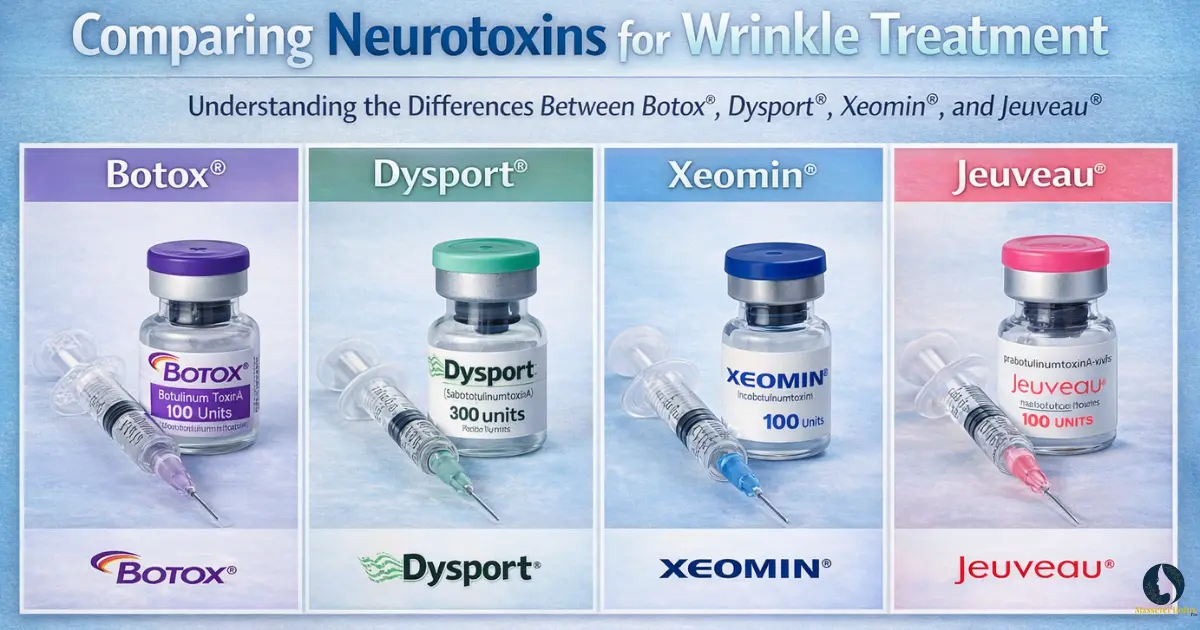
Botox is commonly used as a general term for botulinum toxin injections, but there are actually four primary FDA-approved neuromodulators used for cosmetic wrinkle treatment. These products relax facial muscles to reduce dynamic wrinkles caused by repetitive movement.
The four main types are Botox®, Dysport®, Xeomin®, and Jeuveau®. While they share a similar mechanism of action, each has slight differences in formulation, diffusion, protein content, and onset characteristics. Understanding these differences helps patients choose the most appropriate treatment.
1. Botox (OnabotulinumtoxinA)
Botox was the first botulinum toxin approved for cosmetic use and remains the most widely recognized brand. It is derived from botulinum toxin type A and contains accessory proteins that stabilize the molecule during manufacturing.
Botox is commonly used to treat forehead lines, frown lines, crow’s feet, and various medical conditions including chronic migraines and hyperhidrosis. Results typically appear within 3–5 days and last around 3–4 months.
2. Dysport (AbobotulinumtoxinA)
Dysport is another botulinum toxin type A product known for slightly faster onset in some patients. It has a smaller protein complex, which may allow it to spread more easily in larger treatment areas.
It is often chosen for treating glabellar lines (frown lines) and larger forehead areas. The dosing units differ from Botox, meaning more Dysport units are required to achieve a similar effect.
3. Xeomin (IncobotulinumtoxinA)
Xeomin is sometimes referred to as a “naked” botulinum toxin because it contains no accessory proteins. This purified formulation may reduce the theoretical risk of antibody resistance over long-term use.
It works similarly to Botox in terms of onset and duration. Xeomin is frequently selected for patients who prefer a formulation without additional stabilizing proteins.
4. Jeuveau (PrabotulinumtoxinA)
Jeuveau is a newer botulinum toxin type A product approved specifically for cosmetic use. It is sometimes marketed as “Newtox” and competes directly with Botox for aesthetic treatments.
Jeuveau has a similar onset and duration profile. Many providers consider it comparable in performance, with slight differences depending on patient response and injector technique.
How All Four Types Work (Bullet Points Only)
- Block nerve signals to muscles
- Prevent muscle contraction
- Smooth dynamic wrinkles
- Reduce repetitive facial movement
- Provide temporary results
- Require maintenance treatments
- FDA-approved for cosmetic use
Common Treatment Areas (Bullet Points Only)
- Forehead lines
- Frown lines (glabellar lines)
- Crow’s feet
- Bunny lines
- Jawline slimming
- Neck bands
- Lip flip
Key Differences Between the 4 Types
- Unit dosing ratios differ
- Diffusion characteristics vary slightly
- Accessory protein presence differs
- Pricing per unit varies
- Brand recognition differs
- Onset time may vary slightly
Who Should Avoid Botulinum Toxin
- Pregnant individuals
- Breastfeeding mothers
- Neuromuscular disorders
- Active skin infections
- Allergy to botulinum toxin
Duration and Maintenance
- Effects last 3–4 months
- Onset within 2–5 days
- Full results by 10–14 days
- Maintenance 3 times per year
- Gradual muscle retraining over time
Comparison Table: The 4 Types of Botox
| Brand | Scientific Name | Accessory Proteins | FDA Cosmetic Approval | Typical Duration |
| Botox | OnabotulinumtoxinA | Yes | Yes | 3–4 months |
| Dysport | AbobotulinumtoxinA | Yes | Yes | 3–4 months |
| Xeomin | IncobotulinumtoxinA | No | Yes | 3–4 months |
| Jeuveau | PrabotulinumtoxinA | Yes | Yes | 3–4 months |
Unit Conversion Comparison
| Product | Unit Conversion Compared to Botox |
| Botox | 1:1 baseline |
| Xeomin | 1:1 with Botox |
| Dysport | Approx. 2.5–3:1 |
| Jeuveau | 1:1 similar to Botox |
Onset Time Comparison
| Product | Average Onset |
| Botox | 3–5 days |
| Dysport | 2–4 days |
| Xeomin | 3–5 days |
| Jeuveau | 3–5 days |
Cost Overview (Varies by Region)
| Product | Average Cost Per Unit (USD) |
| Botox | $10–15 |
| Dysport | $4–8 |
| Xeomin | $9–13 |
| Jeuveau | $8–12 |
Frequently Asked Questions
What are the 4 types of Botox?
The four primary types are Botox, Dysport, Xeomin, and Jeuveau. All are botulinum toxin type A neuromodulators used to relax facial muscles and reduce wrinkles. They differ slightly in formulation, protein content, and dosing ratios.
Which type of Botox lasts the longest?
All four typically last around three to four months. Individual metabolism, muscle strength, and injection technique can influence duration more than brand choice.
Is Xeomin better than Botox?
Xeomin contains no accessory proteins, which some patients prefer. However, clinical outcomes are generally comparable when administered properly.
Why does Dysport require more units?
Dysport units are measured differently and are not equivalent to Botox units. A higher number of Dysport units is required to achieve similar muscle relaxation.
Is Jeuveau only for cosmetic use?
Yes, Jeuveau is FDA-approved specifically for aesthetic wrinkle treatment and not for medical conditions.
Are all 4 types safe?
Yes, when administered by qualified healthcare professionals. Side effects are usually mild and temporary.
Can you switch between brands?
Yes, patients can switch brands if recommended by their provider based on response or preference.
Do all types work the same way?
Yes, all four block nerve signals to muscles, reducing contraction and smoothing dynamic wrinkles.
Which type spreads more?
Dysport may diffuse slightly more in larger areas, though this depends on injection technique.
Is one type stronger than the others?
Strength depends on unit measurement rather than potency. Conversion ratios must be considered.
How quickly do results appear?
Most patients see initial changes within 2–5 days, with full results by two weeks.
Can these treat medical conditions?
Botox, Dysport, and Xeomin are approved for certain medical uses. Jeuveau is cosmetic only.
Are results permanent?
No, all neuromodulator effects are temporary and require maintenance.
Which is best for beginners?
All four are suitable; the choice depends on provider experience and patient anatomy.
Can men use all four types?
Yes, all are safe and effective for male patients, though dosing may differ.