In the era of Zoom calls and high-definition selfies, the neck has become a dead giveaway of age. Often neglected in daily skincare routines, the neck and jawline are among the first areas to show signs of sagging, banding, and loss of definition. If you have noticed vertical bands running down your neck when you speak or feel your jawline is losing its sharp contour, there is a revolutionary non-surgical treatment designed specifically for you: the Nefertiti Neck Lift.
Named after the ancient Egyptian queen renowned for her elegant, elongated neck and sculpted profile, this treatment uses the power of neuromodulators (like Botox, Xeomin, or Dysport) to redefine the lower face. But is it right for you? How does it compare to surgery? And most importantly, what results can you expect?
This comprehensive guide covers everything you need to know about the Nefertiti Lift, from the science behind the injections to cost, recovery, and before-and-after outcomes.
What is a Nefertiti Neck Lift?
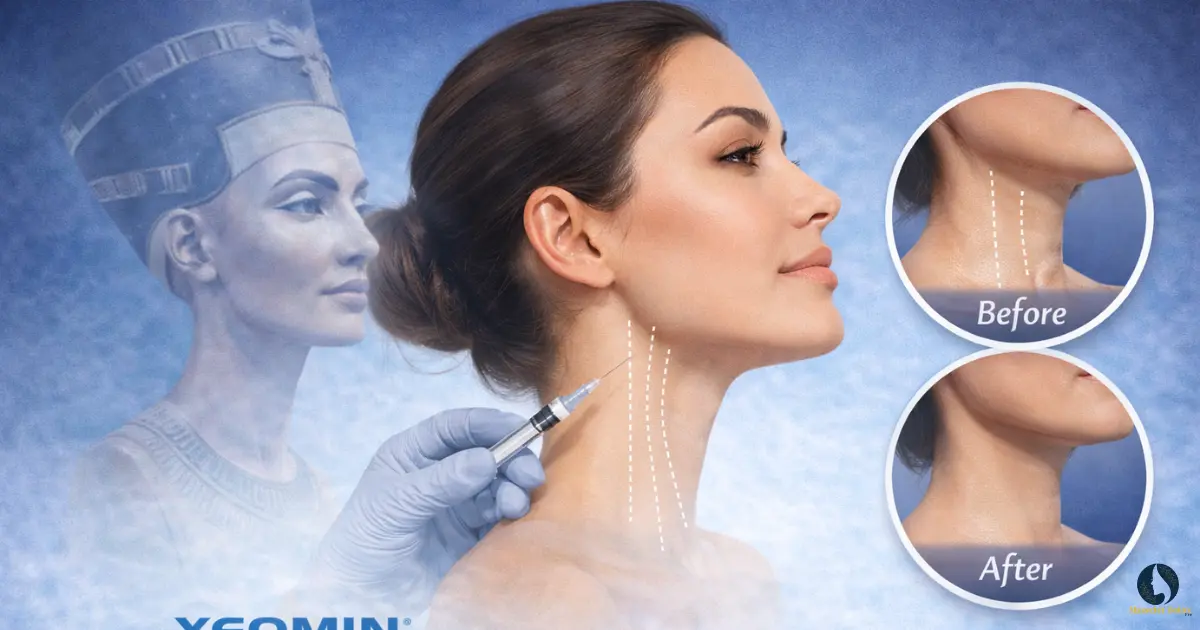
The Nefertiti Lift is a non-surgical cosmetic procedure that uses targeted injections of botulinum toxin (commonly referred to by brand names like Botox, Xeomin, or Dysport) to lift and tighten the jawline and neck .
It gets its name from Queen Nefertiti, whose bust features a famously refined jawline and a long, graceful neck . The goal of the treatment is to replicate that aesthetic—creating a smoother, more contoured transition from the face to the neck without going under the knife.
While the name sounds modern (and has recently gone viral on TikTok), the technique was first described in a scientific paper back in 2007 by a Swiss doctor, Phillip Levy . For years, it has been the “best-kept secret” of dermatologists and plastic surgeons for treating the lower face.
How Does It Work? The Science of the Platysma Muscle
To understand the Nefertiti Lift, you must first understand the platysma muscle.
The Anatomy of Aging
The platysma is a broad, sheet-like muscle that extends from your collarbone (clavicle) up the side of your neck to your jawline and the corner of your mouth . It is a key depressor muscle, meaning its primary function is to pull things downward. Every time you grimace, speak, or tense your neck, the platysma contracts.
As we age and the skin loses elasticity, the constant downward pull of the platysma contributes to:
- Sagging jowls
- Loss of jawline definition
- The formation of vertical platysmal bands (often called “turkey neck”)
The Injection Logic
The Nefertiti Lift injects a neuromodulator directly into the platysma muscle . By relaxing this downward-pulling muscle, the upward muscles of the face (the elevators) are able to work unopposed. This “releases” the pull on the jawline, allowing the skin to tighten and lift subtly .
- Result: The jawline looks sharper, the neck appears longer, and vertical bands soften significantly.
Key Benefits: Why Choose a Nefertiti Lift?
Patients choose the Nefertiti Lift for a variety of reasons, from preventative maintenance to reversing early signs of aging.
| Benefit | Description |
| Non-Surgical & Minimal Downtime | Unlike a surgical neck lift, there are no incisions, scars, or general anesthesia. You can return to work the same day . |
| Jawline Definition | It sharpens the jawline by relaxing the muscles that pull it down, often providing a subtle “contour” effect without filler . |
| Reduces Platysmal Bands | It effectively treats the vertical “stringy” bands that pop out when you talk or smile . |
| Preventative Aging | For patients in their 30s and 40s, it can prevent the platysma from becoming overactive and pulling the skin down prematurely . |
| Natural Results | When done correctly, it doesn’t change your expression; it simply restores the natural resting position of your jawline . |
Nefertiti Lift vs. Surgical Neck Lift: A Comparison
It is vital to understand that the Nefertiti Lift is not a replacement for surgery in cases of severe aging. Here is how they stack up:
| Feature | Nefertiti Lift (Non-Surgical) | Traditional Neck Lift (Surgical) |
| Invasiveness | Minimally invasive (injections) | Highly invasive (incisions) |
| Anesthesia | None (topical numbing optional) | General anesthesia |
| Target Area | Muscle activity (platysma) | Excess skin, fat, and muscle |
| Downtime | None to 24 hours | 2 to 4 weeks |
| Best Candidate | Mild to moderate sagging, good skin elasticity | Severe sagging, excess fat, loose skin |
| Cost | $$ ($500 – $2,000) | $$$$ ($8,000 – $15,000+) |
| Duration of Results | 3 to 6 months (maintenance required) | 10+ years (permanent structural change) |
The Ideal Candidate: Who Is It For?
The Nefertiti Lift is versatile, but it isn’t for everyone. According to board-certified dermatologists, the best candidates are those with mild to moderate skin laxity .
You are a good candidate if you:
- Notice vertical neck bands (platysmal bands) when you speak or grimace .
- Feel your jawline has softened or blurred compared to your youth .
- Have mild jowls starting to form .
- Want a preventative treatment to delay the need for surgery .
- Are looking for a quick pick-me-up before a major event.
You may need a different treatment if you:
- Have significant loose, hanging skin (crepey skin) .
- Have excessive submental fat (a double chin) that requires fat reduction (kybella/coolsculpting).
- Are pregnant, breastfeeding, or have a neuromuscular disease .
Note: The Nefertiti Lift targets the muscles. It will not fix horizontal “tech neck” lines or crepey skin texture. Those often require fillers, lasers, or radiofrequency treatments .
The Procedure: Step-by-Step
If you are considering this treatment, here is exactly what happens during a typical session, based on first-hand accounts and clinical data .
Step 1: Consultation and Marking
Your practitioner will ask you to tense your neck or grimace to identify the strongest bands of the platysma muscle. They will use a surgical marker to draw dots along the jawline and the bands, mapping out the injection sites .
Step 2: The Injections
Using a very fine needle, the practitioner injects small amounts of the neuromodulator into the marked areas. This includes:
- The lower jawline (to lift the corner of the mouth and jowls)
- The vertical platysmal bands on the neck
Most patients receive between 20 to 60 units of product, depending on the strength of the muscle . The procedure itself takes about 5 to 15 minutes .
Step 3: Post-Procedure
You might experience a few tiny red bumps. You can apply makeup immediately and return to work. You will be advised to:
- Remain upright for 4 hours (no lying down).
- Avoid strenuous exercise for 24 hours.
- Avoid massaging the neck to prevent the toxin from spreading .
Results Timeline: What to Expect
The Nefertiti Lift is not instant, but the wait is worth it.
| Timeframe | What Happens |
| Day 1-2 | Initial mild redness/swelling subsides. Muscle activity begins to slow. |
| Day 5-7 | You may notice the neck bands softening and the jawline feeling “lighter.” |
| Day 14 (2 Weeks) | Full results are visible. The jawline is at its sharpest, and bands are maximally relaxed . |
| Month 3-4 | Results begin to gradually wear off as muscle action returns . |
| Month 6 | Some patients report results lasting up to 6 months, but 3-4 is the average . |
Cost Analysis: How Much Does It Cost?
Pricing for the Nefertiti Lift varies widely based on geography, provider expertise, and the number of units required. Because this is an off-label use (though expected to receive FDA approval soon), clinics price it differently .
- Average Cost: $800
- Price Range: $500 to $2,000
Why the range?
- Unit Pricing: If you pay per unit (usually $10-$20/unit), a 50-unit treatment could be $500-$1,000.
- Area Pricing: Some high-end plastic surgeons charge a flat fee for the “neck and jawline” area, ranging from $1,200 to $2,000 .
Potential Side Effects and Risks
While generally safe, the Nefertiti Lift carries risks, particularly because the neck contains muscles involved in swallowing .
Common Side Effects
- Temporary redness, swelling, and bruising at injection sites .
- Mild headache.
Rare but Serious Risks
- Dysphagia (Difficulty Swallowing): If the toxin spreads too deeply into the neck muscles, it can affect swallowing. This is why choosing an expert injector is critical .
- Asymmetry: Uneven relaxation of the muscles can cause a crooked smile or uneven neck appearance (usually temporary) .
Conclusion: Is the Nefertiti Lift Worth It?
The Nefertiti Neck Lift represents a significant advancement in non-surgical aesthetics. For the millions of people who are bothered by their profile when they see themselves in photos or video calls, it offers a solution that is quick, relatively affordable, and free of downtime.
By understanding the anatomy and setting realistic expectations, patients can achieve a profile that is more defined, youthful, and elegant, just like the ancient queen who inspired it. If you are noticing the first signs of aging in your lower face, consult with a board-certified dermatologist or plastic surgeon to see if the Nefertiti Lift is your path to a royal transformation.
Frequently Asked Questions (FAQs)
What is a Nefertiti Lift?
It is a non-surgical cosmetic treatment that uses Botox or similar neuromodulators to relax the platysma muscle in the neck, resulting in a lifted jawline and reduced neck bands.
How long does a Nefertiti Lift last?
Results typically last between 3 to 4 months. With consistent maintenance, some patients find the effects last slightly longer over time.
Is the Nefertiti Lift painful?
Most patients report minimal discomfort. The sensation is often described as a series of quick, small pinches. No anesthetic is usually required.
How much does a Nefertiti Lift cost?
The cost ranges from $500 to $2,000, with an average of around $800. This depends on the provider and the amount of product needed.
Can you get a Nefertiti Lift with Xeomin or Dysport?
Yes. While often called “Botox for the neck,” any neuromodulator (Xeomin, Dysport, Jeuveau, Daxxify) can be used. In fact, the Allure writer received her treatment with Daxxify.
What is the downside?
The main downsides are that results are temporary (requiring repeat treatments) and that it is ineffective for severe skin sagging. There is also a small risk of temporary asymmetry.
What is the best age for a Nefertiti Lift?
There is no “best age.” Patients range from their 30s (prevention) to their 70s (correction), provided they have mild to moderate laxity.
Does it help with jowls?
Yes. By relaxing the downward pull of the platysma, it can soften the appearance of early jowls and prevent them from worsening.
When will I see results?
Initial changes are visible within a few days, but the full, optimal results are seen at the 2-week mark.
Can I combine it with other treatments?
Absolutely. It is often combined with dermal fillers for the jawline, HIFU for skin tightening, or radiofrequency to address crepey skin.
Will it help with “tech neck” lines?
No. Horizontal neck lines (tech neck) are wrinkles in the skin, not caused by muscle pull. These are best treated with fillers or lasers.
What is the recovery time?
There is zero downtime. You can resume normal activities immediately, though you should avoid exercise for 24 hours.
Is the Nefertiti Lift FDA approved?
Currently, using neuromodulators for the neck/platysma bands is considered “off-label” in the USA, though an FDA approval for this specific use is pending a decision soon. It is widely practiced and accepted as safe by experts.
How many units are needed?
Most patients require between 20 and 60 units, depending on the strength and size of their platysma muscle.
Who should avoid this treatment?
Individuals with severe skin laxity, neuromuscular disorders, or who are pregnant or breastfeeding should avoid the Nefertiti Lift.