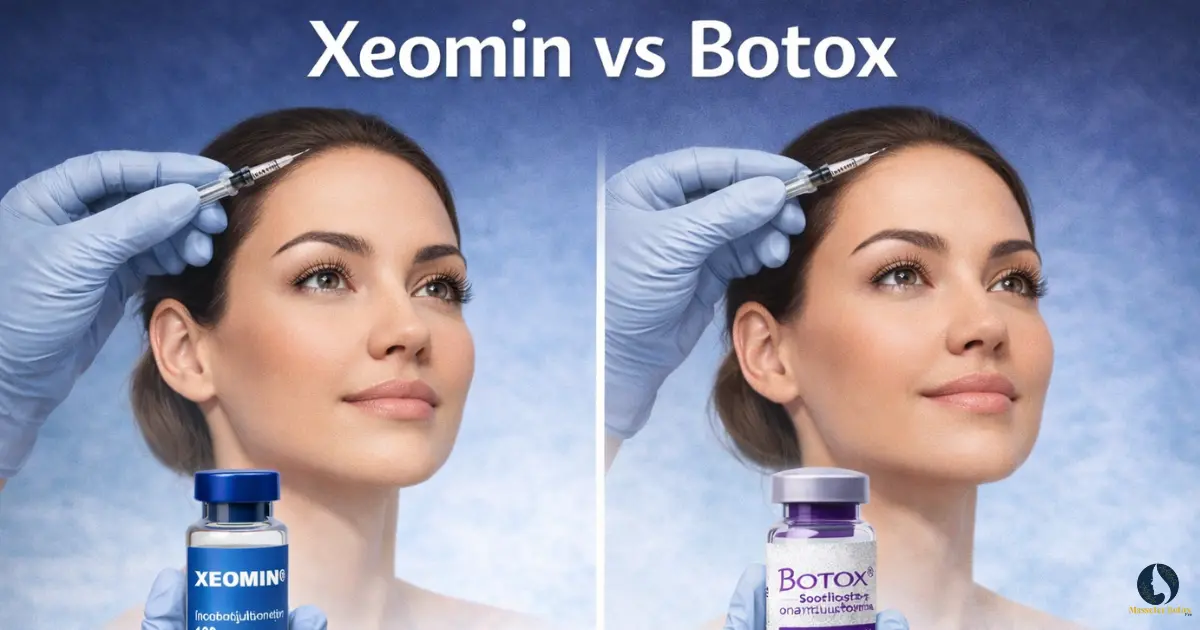
When it comes to smoothing forehead lines, softening crow’s feet, or treating medical conditions like cervical dystonia, two names dominate the conversation: Xeomin and Botox. While both are household names in the world of aesthetics, they are not identical. For decades, Botox has been the gold standard, but Xeomin has emerged as a powerful contender, often touted as the “cleaner” alternative.
If you are trying to decide between these two neuromodulators, you likely have questions about cost, longevity, side effects, and which one looks more natural. This comprehensive guide will break down the Xeomin vs Botox debate point by point, helping you make an informed decision based on your aesthetic goals and medical history.
What Are Xeomin and Botox?
Before diving into the differences, it is crucial to understand that both products share the same foundation. They are both classified as botulinum toxin type A injections. They work by blocking nerve signals to the muscles into which they are injected, causing those muscles to relax. This relaxation smooths the overlying skin, reducing the appearance of dynamic wrinkles—the lines caused by repetitive facial expressions like frowning or squinting .
- Botox (OnabotulinumtoxinA): Manufactured by AbbVie (formerly Allergan), Botox has been FDA-approved since 1989 for medical use and since 2002 for cosmetic use. It is the most studied and widely recognized neuromodulator in the world .
- Xeomin (IncobotulinumtoxinA): Manufactured by Merz Pharmaceuticals, Xeomin gained FDA approval in 2011. It is often referred to as the “naked” neurotoxin because of its unique formulation process .
Key Differences: Xeomin vs Botox
While the results are similar, the science behind the vials is different. Understanding these nuances is key to choosing the right option for long-term treatment.
1. Formulation: The “Naked” Toxin vs. The Protein Complex
The most significant difference lies in their composition.
- Botox contains the botulinum toxin type A complex along with accessory (complexing) proteins. These proteins have historically been used to protect the neurotoxin during manufacturing and storage .
- Xeomin is a pure formulation. It contains only the 150 kDa neurotoxin without any accessory proteins. This means it has been purified to remove inactive proteins, leaving only the active ingredient .
2. Protein Load and Immunogenicity (The Resistance Factor)
Because Xeomin lacks these accessory proteins, it has a lower protein load. This is a critical factor for patients concerned about developing resistance.
- The Risk: When the body is repeatedly exposed to foreign proteins (like the accessory proteins in Botox), there is a small chance the immune system will develop neutralizing antibodies. These antibodies can block the effects of the toxin, making treatments less effective over time—a phenomenon often described as “treatment resistance” .
- The Numbers: Xeomin contains approximately 0.6 ng of clostridial protein per 100 units, compared to Botox, which contains about 5 ng per 100 units . Clinical studies suggest the incidence of neutralizing antibody formation with Xeomin is very low (around 0.3%), making it a potential option for those who have stopped responding to other neurotoxins .
3. FDA-Approved Uses
Both products are versatile, but Botox has a longer history and therefore more approved indications.
- Botox is approved for a wider range of conditions, including chronic migraines, overactive bladder, excessive underarm sweating (hyperhidrosis), and upper limb spasticity .
- Xeomin is approved for cervical dystonia, blepharospasm (eye twitching), upper limb spasticity, and chronic sialorrhea (excessive drooling) .
- Cosmetic Approvals:
- Botox Cosmetic: Glabellar lines (frown lines), Crow’s feet (lateral canthal lines), and Forehead lines .
- Xeomin: Glabellar lines (frown lines), Forehead lines, and Crow’s feet .
4. Onset of Results
How quickly do they work?
- Botox typically begins to work within 1 to 2 days for cosmetic purposes, with full effects visible around the 30-day mark .
- Xeomin may have a slight edge in speed. According to some studies and manufacturer data, the average time to start working is within 2 to 7 days after injection. One study involving 180 patients actually found that Xeomin worked faster and lasted longer than Botox for glabellar lines .
5. Longevity of Results
For most patients, both treatments are temporary.
- The effects of both Xeomin and Botox typically last between 3 to 4 months .
- However, some patients report that Xeomin can last slightly longer, sometimes up to 6 months, depending on the individual’s metabolism and the area treated . Regular treatment sessions are required to maintain results.
6. Dosage and Diffusion
- Dosing: Xeomin and Botox are considered clinically equivalent on a 1:1 unit basis. This means that 1 unit of Xeomin has a similar effect to 1 unit of Botox, making it easy for practitioners to switch between them without complex dosage calculations .
- Diffusion: Some practitioners believe that Xeomin may have a slightly different diffusion pattern, but clinical consensus holds that both products offer precise, localized results when injected correctly.
7. Cost Comparison
Price is often a deciding factor. According to pricing data, Xeomin is generally the more affordable option.
- Botox averages around $683 per 100 units.
- Xeomin averages around $542 per 100 units .
- Total Treatment Cost: The American Society of Plastic Surgeons notes that the average cost of a botulinum toxin type A treatment session is around $435, though this varies based on geography and the number of units required (typically 20-40 units for areas like the forehead or frown lines) . Xeomin’s lower unit price can lead to significant savings over time.
At a Glance: Xeomin vs Botox Comparison Table
| Feature | Xeomin (IncobotulinumtoxinA) | Botox / Botox Cosmetic (OnabotulinumtoxinA) |
| Formulation | “Naked” neurotoxin; Pure 150 kDa; No accessory proteins | Contains botulinum toxin complex with accessory proteins |
| Protein Load | Low (~0.6 ng per 100 units) – Reduced immunogenicity risk | Higher (~5 ng per 100 units) |
| Cosmetic Approvals | Frown lines, Forehead lines, Crow’s feet | Frown lines, Forehead lines, Crow’s feet, Neck bands |
| Medical Approvals | Cervical dystonia, Blepharospasm, Sialorrhea, Spasticity | Chronic migraine, Overactive bladder, Hyperhidrosis, Spasticity, etc. |
| Onset of Results | Average: 2-7 days (May be faster in some studies) | Average: 1-2 days for cosmetic |
| Duration | 3 to 4 months (up to 6 months reported) | 3 to 4 months |
| Unit Conversion | 1:1 with Botox | 1:1 with Xeomin |
| Average Cost | ~$542 / 100 units (Generally more cost-effective) | ~$683 / 100 units |
| Storage | Can be stored at room temperature before reconstitution | Requires refrigeration |
Benefits and Advantages
Why Choose Xeomin?
- Purity: The lack of complexing proteins makes it ideal for patients who are concerned about long-term immunogenicity or have sensitive systems .
- Reduced Resistance Risk: Its low protein load minimizes the chance of developing neutralizing antibodies that could render future treatments无效 .
- Natural Results: Many injectors find the pure formula allows for a very natural, “soft” look without the frozen appearance .
- Convenience: Unlike Botox, Xeomin does not require refrigeration before it is mixed, making storage and handling simpler .
Why Choose Botox?
- Proven Track Record: With over 30 years of clinical use and extensive studies, Botox has the longest safety and efficacy profile .
- Predictability: Because it has been used millions of times, providers know exactly how it will behave in every area of the face and body.
- Versatility: It is approved for more medical conditions than any other neuromodulator, making it a one-stop solution for patients needing both cosmetic and therapeutic relief .
Side Effects and Safety Considerations
Both Xeomin and Botox carry similar side effect profiles. They are generally safe when administered by a trained professional, but they do carry a Boxed Warning regarding the potential for the toxin to spread beyond the injection site, which could cause symptoms similar to botulism (e.g., swallowing or breathing difficulties) .
Common Side Effects Include:
- Pain, swelling, or bruising at the injection site
- Headache (reported in about 5% of patients for frown lines)
- Dry mouth or dry eyes (depending on injection area)
- Temporary drooping of the eyelid (ptosis) if the toxin migrates
Who Should Avoid These Treatments?
- Individuals with allergies to botulinum toxin or any components of the formulation.
- Those with infections at the proposed injection site.
- Pregnant or breastfeeding women.
- Patients with neuromuscular disorders (like Myasthenia Gravis or Lambert-Eaton Syndrome) .
Conclusion: Which One Should You Choose?
In the battle of Xeomin vs Botox, there is no single winner—only the right choice for your unique biology and goals.
Choose Xeomin if you are a first-time user concerned about long-term immunity, if you have sensitive skin, or if you are looking for a pure formulation with a slightly lower price tag. Its “naked” structure makes it a smart choice for the long haul .
Choose Botox if you want the reassurance of the most extensively studied product on the market, if you need treatment for a medical condition like migraines or hyperhidrosis, or if you prefer the “tried and true” standard that has satisfied millions of patients worldwide .
Ultimately, the most critical factor is not the vial, but the hands holding the syringe. Always consult with a board-certified dermatologist or plastic surgeon who can assess your facial anatomy and tailor the treatment to ensure you look refreshed, natural, and confident.
Frequently Asked Questions – Xeomin vs Botox
Is Xeomin better than Botox?
There is no “better” option, only a “better fit.” Xeomin is ideal for those seeking a pure formula with lower risk of long-term resistance. Botox is ideal for those wanting the most studied and predictable treatment available.
Can you switch from Botox to Xeomin?
Yes. Because they have a 1:1 conversion ratio, patients can safely switch between Botox and Xeomin without changing the dosage protocol.
Which lasts longer, Xeomin or Botox?
Most studies show they last similarly (3-4 months). However, some patient surveys and studies suggest Xeomin may have a slight edge in longevity for certain individuals.
Does Xeomin take longer to work than Botox?
No. Xeomin may actually work slightly faster for some patients, with results visible in as little as 2-3 days.
Why is Xeomin cheaper than Botox?
Pricing is often determined by market presence and manufacturing costs. Xeomin is often positioned as a cost-effective, premium alternative to the market-leading Botox.
Can Xeomin be used for migraines?
Currently, Xeomin is not FDA-approved for chronic migraines. Botox is the approved neuromodulator for that specific indication.
What is the “protein load” in neurotoxins?
It refers to the amount of clostridial proteins (active and inactive) present in the injection. A lower protein load, like that of Xeomin, is associated with a lower risk of antibody formation.
Which product is better for preventing a “frozen face”?
The result depends more on the injector’s skill than the product. However, Xeomin’s pure formulation is often preferred by those seeking very subtle, natural-looking results.
How many units of Xeomin do I need for forehead lines?
Typically, 10-20 units for the forehead and 10-20 units for the glabellar complex (frown lines) are standard, mirroring Botox dosages.
Can Xeomin help with excessive sweating?
Xeomin is not FDA-approved for hyperhidrosis (excessive sweating). Botox is the approved treatment for this condition.
Is there a difference in pain between the two injections?
No. Both use very fine needles, and the sensation is generally described as a mild pinch. Technique matters more than the drug.
Does Xeomin need to be refrigerated?
No. One of Xeomin’s advantages is that it can be stored at room temperature prior to reconstitution, whereas Botox requires refrigeration.
What happens if I develop resistance to Botox?
If Botox stops working for you, a switch to Xeomin is often recommended because its lack of accessory proteins may be effective in patients who have developed neutralizing antibodies.
Which one is better for crow’s feet?
Both are FDA-approved for crow’s feet and are considered equally effective in this area.
How often should I get treated?
Treatments should be spaced at least 3 to 4 months apart to allow muscle activity to gradually return and to prevent antibody formation.