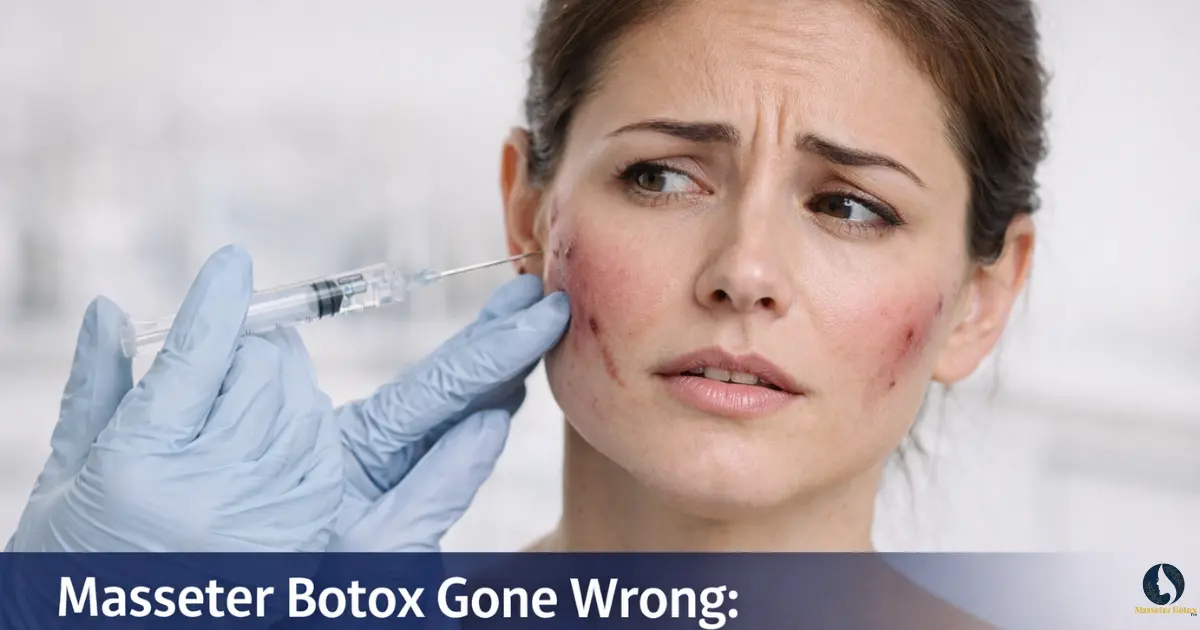
Masseter Botox has become one of the most popular non-surgical treatments for jaw slimming, teeth grinding relief, and TMJ pain management. When performed correctly by a qualified provider, it offers remarkable results with minimal risk. However, like any medical procedure, things can sometimes go wrong.
If you’re researching “masseter botox gone wrong,” you’re likely concerned about potential complications or perhaps experiencing an issue yourself. This comprehensive guide covers everything you need to know about masseter Botox complications—what can go wrong, how common these issues are, how long they last, and most importantly, what you can do about them.
Quick Takeaways: Masseter Botox Complications at a Glance
| Key Fact | Information |
| Complication Rate | 0.48% of patients experience adverse events (223 out of 46,250 patients) |
| Most Common Complication | Paradoxical bulging (88.3% of all complications) |
| Recovery Time | Average 5.3 months for complete resolution |
| All Complications | Temporary and resolve completely |
| Onset of Issues | Typically within 2-4 weeks after injection |
| Resolution Window | Most resolve within 12 weeks, though some take longer |
What Can Go Wrong with Masseter Botox?
A large-scale 2024 study of 46,250 patients who received masseter Botox injections found that only 223 patients (0.48%) experienced adverse events requiring follow-up . While complications are rare, understanding them helps you make informed decisions and recognize issues early.
Complete List of Potential Complications
| Complication | Description | Incidence |
| Paradoxical Bulging | Unexpected muscle protrusion when clenching | 88.3% of all complications |
| Facial Asymmetry | Uneven results between left and right sides | Varies |
| Crooked Smile | Asymmetrical smile due to toxin spread to risorius muscle | Occasional |
| Chewing Weakness | Difficulty chewing tough foods | Common with higher doses |
| Sagging Skin | Jowling or loose skin in older patients | Risk with over-treatment |
| Bruising | Minor bleeding at injection sites | Most common minor side effect |
| Parotitis | Inflammation of parotid salivary gland | Rare (case reports) |
| Bone Changes | Possible osteopenia with long-term high doses | Theoretical risk |
The #1 Most Common Complication: Paradoxical Bulging
The most frequently reported complication when masseter Botox goes wrong is paradoxical masseteric bulging .
What Is Paradoxical Bulging?
Paradoxical bulging refers to an unexpected occurrence of masseter muscle bulging or protrusion following Botox injections—the exact opposite of the desired muscle weakening effect . Instead of a slimmer jawline, patients notice a visible bulge when they clench their teeth.
Why Does It Happen?
This complication occurs due to the unique anatomy of the masseter muscle. A broad tendon structure called the deep inferior tendon (DIT) runs through the superficial layer of the masseter muscle, dividing it into superficial and deep bellies .
When toxin is injected underneath the DIT, it gets blocked from diffusing into the more superficial muscle fibers. This creates a discrepancy between the contractile capabilities of the deep and superficial layers. The non-paralyzed superficial muscle fibers overcompensate, creating prominent bulging .
How Common Is It?
- 88.3% of all masseter Botox complications are paradoxical bulging
- Incidence rate ranges from 0.5% to 18.8% in various studies
How Long Does It Last?
| Statistic | Value |
| Average recovery time | 159.6 days (5.3 months) |
| Range of recovery | 13 to 667 days |
| Maximum recovery | All cases improved within 22.2 months |
Can It Be Fixed?
Yes! If paradoxical bulging develops, it can be corrected with additional units of botulinum toxin carefully injected into the paradoxically contracted muscle fibers. Studies show this correction yields improvement within 1 week and complete correction within 2 weeks .
Other Common Complications When Masseter Botox Goes Wrong
1. Facial Asymmetry
What it is: Uneven results where one side of the jaw appears different from the other.
Why it happens:
- Improper dose adjustment between sides
- Injection outside safety zones
- Pre-existing asymmetry not addressed
Prevention: Proper pre-treatment assessment and dose adjustments; inject within safety zones .
2. Crooked Smile (Asymmetric Smile)
What it is: Uneven smile caused by toxin spreading to the risorius muscle or zygomaticus major muscle .
Why it happens: When injections are placed too superficially or too anteriorly, toxin can diffuse to muscles that control the mouth .
Prevention: Ask patients to clench their teeth during injection to identify muscle boundaries; inject well within masseter confines .
3. Chewing Weakness
What it is: Difficulty chewing tough foods like steak, bagels, or chewy bread.
Why it happens:
- Excessive dose
- Too much muscle weakening
Prevention: Use the lowest effective dose; avoid excessive infiltration; consider ultrasound or EMG guidance .
4. Sagging Skin and Jowling
What it is: Loose skin along the jawline after muscle reduction.
Why it happens: In patients over 40 or those with poor skin elasticity, reducing muscle volume can reveal pre-existing skin laxity .
Prevention: Lower injection doses; distribute treatment over several sessions; consider complementary skin tightening treatments .
5. Bruising at Injection Site
What it is: Minor bleeding under the skin causing discoloration.
Why it happens: Needle punctures small blood vessels.
Prevention: Apply local compression immediately post-injection; use smaller-gauge needles .
6. Parotitis (Salivary Gland Inflammation)
What it is: Rare complication involving inflammation of the parotid salivary gland .
Why it happens: Likely due to anatomical proximity of the parotid gland to the masseter muscle; improper injection depth or location may affect the gland .
7. Bone Changes
What it is: Theoretical risk of osteopenia (reduced bone density) with long-term, high-dose treatments .
Prevention: Avoid prolonged or high-dose treatments; monitor long-term effects .
When Do Complications Appear?
Most complications appear within 2 to 4 weeks after injection .
| Timeframe | What Happens |
| Days 1-3 | Bruising, swelling, pain at injection sites |
| Week 1 | Paradoxical bulging may appear |
| Weeks 2-4 | Majority of complications become visible |
| Weeks 4-12 | Peak of aesthetic concerns |
| Week 12+ | Gradual improvement and resolution |
How Long Do Complications Last?
This is the most important thing to know: All adverse events from masseter Botox are temporary .
Recovery Timeline
| Time Period | Status |
| Within 12 weeks | Majority of complications resolve |
| Average 5.3 months | Complete improvement for most patients |
| Up to 22.2 months | Maximum time for complete resolution (rare cases) |
Treatment vs. Observation
A 2024 study found no significant difference between patients who received intervention and those who simply observed—both groups improved at similar rates . This confirms that complications resolve naturally as the Botox wears off.
Risk Factors for Complications
Provider-Related Risks
| Risk Factor | Why It Matters |
| Inexperienced injector | Lack of anatomical knowledge increases risk |
| Non-medical provider | Medspas without medical oversight |
| Improper technique | Single-site injection vs. two-site technique |
| Wrong depth | Injection too superficial or deep |
Patient-Related Risks
| Risk Factor | Consideration |
| Complex anatomy | Varied DIT position requires customized approach |
| Age over 50 | Higher risk of skin laxity |
| Fast metabolism | May affect results but not complications |
| Pregnancy | Avoid treatment entirely |
| Neuromuscular disorders | Higher risk of systemic effects |
Prevention: How to Avoid Masseter Botox Going Wrong
Choosing the Right Provider
The single most important factor in avoiding complications is selecting a qualified, experienced provider .
| Provider Type | Risk Level |
| Board-Certified Dermatologist | Lowest |
| Board-Certified Plastic Surgeon | Lowest |
| Oculofacial Plastic Surgeon | Lowest |
| Experienced Nurse Injector (MD supervised) | Moderate |
| Medspa with rotating staff | Higher |
| “Botox parties” | Highest (avoid completely) |
Questions to Ask Your Provider
- How many masseter Botox procedures have you performed?
- Have you treated complications like paradoxical bulging?
- Do you use ultrasound or EMG guidance?
- What is your two-site injection technique?
- What is your policy if I develop complications?
Proper Injection Technique
To prevent paradoxical bulging specifically, providers should:
- Identify and mark the full extent of the masseter muscle
- Use palpation while patient clenches to locate boundaries
- Administer layer-by-layer injections into both superficial and deep bellies
- Space injections evenly both above and below the deep inferior tendon
- Consider ultrasound guidance for complex anatomy
What to Do If Masseter Botox Goes Wrong
Step 1: Don’t Panic
Remember: All complications are temporary . The Botox will wear off, and your muscle function will return to normal. No permanent damage has been documented with proper use by trained professionals .
Step 2: Contact Your Provider Immediately
Return to your injector for evaluation. They should:
- Assess the complication
- Document with photos
- Discuss treatment options
- Provide follow-up care
Step 3: Understand Your Options
| Complication | Possible Solutions |
| Paradoxical Bulging | Additional small doses into bulging area |
| Asymmetry | Touch-up on under-treated side |
| Crooked Smile | Wait for resolution; rarely treatable |
| Chewing Weakness | Soft diet until muscle returns |
| Bruising | Arnica, ice, concealer |
Step 4: Be Patient
The average recovery time is 5.3 months . Keep in mind:
- Improvement happens gradually
- Intervention doesn’t significantly speed recovery
- Your body will return to normal
Step 5: Document Everything
Keep records of:
- Treatment date and dosage
- Photos of the complication
- Provider communications
- Follow-up appointments
Masseter Botox Gone Wrong: Real Case Examples
Case Study 1: Paradoxical Bulging
A female in her late 40s developed paradoxical masseteric bulging within a week of her masseter Botox injections . She experienced visible bulging when clenching—the opposite of her desired result. The condition was managed with observation and resolved as the Botox wore off .
Case Study 2: Parotitis
A 60-year-old female developed acute parotitis (salivary gland inflammation) following Botox injections to the masseter muscle . This rare complication highlights the importance of anatomical knowledge and proper injection technique .
Case Study 3: Correction Success
A patient with established paradoxical bulging received additional units of botulinum toxin carefully injected into the paradoxically contracted muscle fibers. This yielded improvement within 1 week and complete correction within 2 weeks .
Masseter Botox Gone Wrong: Prevention Table
| Risk | Mitigation Method |
| Facial asymmetry | Ensure proper pre-treatment assessment and dose adjustments; inject within safety zones |
| Chewing weakness | Use the lowest effective dose; avoid excessive infiltration; use ultrasound or EMG guidance |
| Bruising at injection site | Apply local compression immediately post-injection; use smaller-gauge needles |
| Sagging skin and soft tissues | Lower injection doses; distribute treatment over several sessions; complementary skin tightening |
| Paradoxical swelling | Use ultrasound guidance to confirm masseter anatomy; superficial booster doses may help |
| Diffusion to unintended muscles | Ask patients to clench teeth during injection to identify muscle boundaries |
| Bone changes | Avoid prolonged or high-dose treatments; monitor long-term effects |
| Unnatural facial expressions | Inject at appropriate depth and within masseter boundaries |
Summary: Masseter Botox Gone Wrong Quick Reference
| Category | Key Information |
| Complication Rate | 0.48% (223 out of 46,250 patients) |
| Most Common | Paradoxical bulging (88.3% of complications) |
| Onset | 2-4 weeks after injection |
| Recovery Time | Average 5.3 months; all resolve within 22.2 months |
| Permanence | All complications are temporary |
| Prevention | Choose board-certified provider with masseter experience |
| Correction | Additional small doses can fix paradoxical bulging |
| Key Anatomy | Deep inferior tendon (DIT) requires two-site injection |
Conclusion: The Truth About Masseter Botox Gone Wrong
Masseter Botox is overwhelmingly safe when performed by qualified providers. The complication rate is low (0.48%), and all complications are temporary .
The most common issue paradoxical bulging affects a small percentage of patients and can often be corrected with additional treatment . Even without intervention, everything resolves on its own as the Botox wears off.
The key takeaways:
- Choose your provider carefully – Board-certified dermatologists and plastic surgeons with masseter experience offer the safest experience
- Understand the risks – Paradoxical bulging is the most common complication, but it’s temporary
- Don’t panic if something goes wrong – All complications resolve, typically within 3-6 months
- Seek help immediately – Your provider can assess and possibly correct issues
- Document everything – Photos and records help track progress
Remember that millions of successful masseter Botox treatments are performed annually. By understanding what can go wrong, you’re better equipped to prevent complications and handle them effectively if they occur.
Frequently Asked Questions About Masseter Botox Gone Wrong
How common are masseter Botox complications?
Complications requiring follow-up occur in only 0.48% of patients (223 out of 46,250) according to a 2024 study. The vast majority of masseter Botox treatments are safe and effective when performed by qualified providers.
What is the most common complication when masseter Botox goes wrong?
Paradoxical bulging accounts for 88.3% of all complications. This is when the muscle unexpectedly bulges instead of slimming when clenching, caused by toxin being blocked by the deep inferior tendon (DIT) within the masseter muscle.
How long do masseter Botox complications last?
All complications are temporary. The average recovery time is 5.3 months, with all cases improving within 22.2 months maximum. Most complications resolve completely within 12 weeks as the Botox naturally wears off.
Can paradoxical bulging be fixed?
Yes. Additional small doses of botulinum toxin carefully injected into the paradoxically contracted muscle fibers can correct it within 1-2 weeks. Studies show improvement within 1 week and complete correction within 2 weeks.
Will I have a permanent crooked smile from masseter Botox?
No. Any smile asymmetry is temporary and will resolve completely as the Botox wears off. The average duration is 3-4 months. This occurs when toxin spreads to muscles that control the mouth.
Can masseter Botox cause sagging skin or jowling?
In patients over 40 or those with poor skin elasticity, reducing muscle volume can reveal pre-existing skin laxity. This is why proper patient selection and lower doses are important. Prevention includes lower injection doses and distributing treatment over several sessions.
What should I do if I develop a complication?
Step 1: Don’t panic—all complications are temporary
Step 2: Contact your provider immediately for evaluation
Step 3: Document everything with photos
Step 4: Discuss treatment options (additional small doses may help)
Step 5: Be patient—your body will return to normal
How can I prevent masseter Botox from going wrong?
The single most important factor is choosing a qualified, experienced provider. Look for:
- Board-certified dermatologist or plastic surgeon
- Extensive masseter Botox experience
- Proper two-site injection technique
- Willingness to discuss risks and complications
- Before and after photos of actual patients
Are there any permanent side effects of masseter Botox?
No. Studies confirm that all adverse events from masseter Botox are temporary. Muscle function returns completely once treatment is discontinued. No permanent muscle damage has been documented with proper use by trained professionals.
Can I get masseter Botox again after a complication?
Yes, once the complication has fully resolved, you can try again with a more experienced provider who uses proper technique. Wait until the Botox has completely worn off and your muscle function has returned to normal.
What causes paradoxical bulging?
Paradoxical bulging occurs due to the unique anatomy of the masseter muscle. A broad tendon structure called the deep inferior tendon (DIT) runs through the superficial layer, dividing it into superficial and deep bellies. When toxin is injected underneath the DIT, it gets blocked from diffusing into superficial fibers, causing the non-paralyzed superficial layer to overcompensate and create bulging.
Does insurance cover treatment for masseter Botox complications?
Generally no for cosmetic treatments. However, if you have documented medical necessity for bruxism or TMJ, some follow-up care may be covered. Check with your provider and insurance company. Most reputable providers will address complications from their own treatments without additional cost.