Does masseter Botox cause jowls? This is a common concern among people considering Botox for jaw slimming, TMJ pain, or teeth grinding. While masseter Botox is generally safe and effective, improper dosing, poor injection technique, or unsuitable facial anatomy can sometimes lead to unwanted changes such as lower face sagging or the appearance of jowls. Understanding why this happens—and how to prevent it—is essential for achieving natural, balanced results.
Masseter Botox works by relaxing the chewing muscles, not tightening skin. When muscle support is reduced without proper assessment of facial structure, skin laxity, and age-related volume loss, the jawline may appear less defined. However, jowls are not an automatic or common outcome when treatment is performed correctly.
What Is Masseter Botox and Why People Get It
Masseter Botox involves injecting botulinum toxin into the masseter muscles, which are responsible for chewing and clenching. Overactivity of these muscles can cause jaw pain, teeth grinding (bruxism), TMJ-related discomfort, and a wide or square jawline.
Common reasons people choose masseter Botox include:
- Jawline slimming and facial contouring
- Relief from jaw clenching and teeth grinding
- TMJ-related muscle pain reduction
- Headache and facial tension relief
When used conservatively and strategically, Botox for the masseter muscle improves facial balance rather than disrupting it.
Can Masseter Botox Actually Cause Jowls?
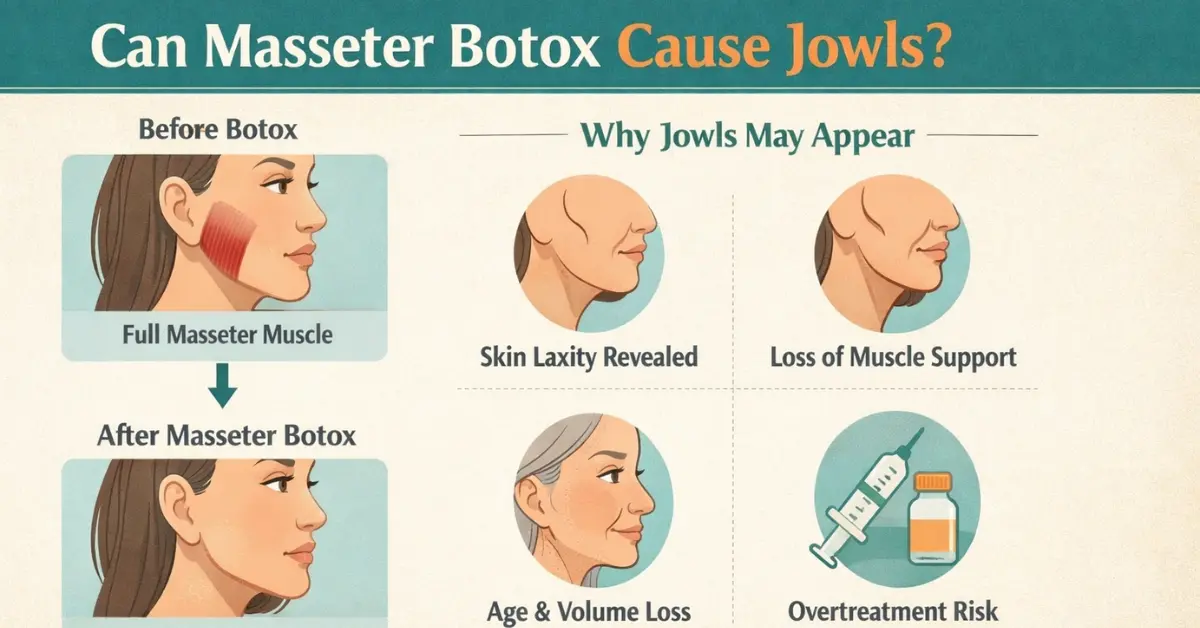
Masseter Botox does not directly cause jowls, but it can reveal or worsen existing lower face sagging in certain individuals. This usually happens when muscle volume is reduced without considering the role the masseter muscle plays in supporting the lower face.
Why jowls may appear after masseter Botox:
- Reduced muscle bulk can uncover pre-existing skin laxity
- Over-treated masseter muscles lose structural support
- Age-related collagen loss becomes more visible
- Facial volume loss was already present
- Jawline contour relied heavily on muscle support
In these cases, Botox does not create jowls—it removes camouflage that the muscle previously provided.
Masseter Botox and Facial Sagging: Understanding the Anatomy
The lower face relies on a balance of muscle tone, skin elasticity, fat pads, and bone structure. The masseter muscle contributes to jawline firmness, especially in people with strong chewing muscles.
When Botox reduces muscle activity:
- Muscle atrophy may occur gradually
- Skin may have less underlying support
- Jawline definition may soften
- Existing sagging may become more noticeable
This is why facial anatomy and Botox planning are critical before treatment.
Who Is More at Risk of Jowls After Masseter Botox?
Certain individuals are more prone to noticing jowls or facial sagging after jaw Botox.
Higher-risk profiles include:
- People over 35 with skin laxity
- Individuals with early jowling before treatment
- Patients with facial volume loss
- Overtreated masseter muscles
- Aggressive or repeated high-dose Botox
This does not mean these people should avoid masseter Botox—only that dosing and technique must be adjusted carefully.
Masseter Botox Gone Wrong: What Usually Causes It
When people report “masseter Botox gone wrong,” it’s rarely due to Botox itself. The most common causes are:
- Excessive units injected too quickly
- Poor injector understanding of jaw anatomy
- Treating jaw slimming without facial balance planning
- Ignoring skin laxity and aging factors
- Not combining Botox with supportive treatments when needed
Jaw Botox risks increase when treatment is done purely for slimming without medical or anatomical evaluation.
TMJ Botox and Jowls: Is There a Connection?
TMJ Botox jowls are occasionally reported, but again, this is not a direct cause-and-effect issue. TMJ treatments often use higher doses because muscle overactivity is more severe.
If high doses are used:
- Muscle bulk decreases rapidly
- Jaw support changes quickly
- Skin may not adapt immediately
This is why TMJ Botox should be done conservatively and gradually, especially in patients concerned about facial sagging.
How Proper Technique Prevents Jowls After Masseter Botox
Experienced injectors use conservative Botox dosing and strategic placement to preserve facial support.
Best practices include:
- Gradual dose reduction over multiple sessions
- Avoiding over-weakening the muscle
- Assessing skin laxity before treatment
- Balancing facial proportions, not just jaw width
- Combining Botox with supportive treatments if needed
This approach protects jawline contouring while maintaining facial harmony.
Facial Balance After Masseter Botox
The goal of masseter Botox is balance, not extreme slimming. A well-performed treatment should:
- Maintain jawline definition
- Avoid lower face drooping
- Preserve natural facial proportions
- Improve comfort and aesthetics simultaneously
When facial balance is prioritized, masseter Botox enhances appearance rather than compromising it.
Non-Surgical Jawline Slimming Without Jowls
For patients concerned about sagging, masseter Botox can be combined with other non-surgical options, such as:
- Skin-tightening treatments
- Collagen-stimulating procedures
- Subtle jawline contouring support
- Conservative maintenance dosing
This holistic approach reduces the risk of jowls while delivering optimal results.
Final Verdict: Does Masseter Botox Cause Jowls?
Masseter Botox does not inherently cause jowls.
Jowls may appear only when underlying skin laxity, volume loss, or overtreatment is present. With proper assessment, conservative dosing, and expert injection technique, masseter Botox remains a safe, effective option for jaw slimming, TMJ relief, and facial balance.
References
- American Academy of Dermatology (AAD)
Provides clinical guidance on Botox safety, facial muscle relaxation, cosmetic dosing, and effects on facial balance.
https://www.aad.org - Mayo Clinic
Trusted medical source explaining botulinum toxin uses, side effects, muscle weakening, and long-term safety considerations.
https://www.mayoclinic.org - Plastic and Reconstructive Surgery Journal
Peer-reviewed studies on masseter Botox, muscle atrophy, jawline slimming, and facial contour changes after treatment.
https://journals.lww.com/plasreconsurg - Journal of Oral & Maxillofacial Surgery
Clinical research on Botox for TMJ disorders, jaw muscle overactivity, dosing risks, and functional outcomes.
https://www.joms.org - International Association for Dental Research (IADR)
Evidence-based information on bruxism, jaw clenching, and therapeutic Botox use for chewing muscles.
https://www.iadr.org - Cleveland Clinic
Medical explanations covering cosmetic and therapeutic Botox, facial anatomy, jaw muscles, and non-surgical treatments.
https://my.clevelandclinic.org - Kim et al., 2012 – Plastic and Reconstructive Surgery
Clinical study demonstrating masseter muscle volume reduction, facial width changes, and temporary effects of Botox.
(Plastic and Reconstructive Surgery Journal)
Can masseter Botox actually cause jowls?
Are jowls from masseter Botox permanent?
Who is most at risk of developing jowls after masseter Botox?
| Higher Risk Factors | Why It Matters |
|---|---|
| Skin laxity | Reduced support after muscle relaxation |
| Facial volume loss | Jowls become more visible |
| Age 40+ | Natural collagen decline |
| High Botox doses | Excess jaw muscle weakening |
How long after masseter Botox do jowls appear?
Can masseter Botox make you look older?
How can jowls be prevented with masseter Botox?
| Prevention Strategy | Benefit |
|---|---|
| Gradual dosing | Maintains jaw muscle support |
| Facial assessment | Identifies laxity early |
| Balanced injections | Preserves jawline contour |
| Staged treatments | Avoids sudden facial changes |
What should I do if I notice jowls after jaw Botox?
Does TMJ Botox increase the risk of facial sagging?
Is masseter Botox safe for patients over 40?
Can fillers fix jowls caused by masseter Botox?
| Treatment Option | Purpose |
|---|---|
| Jawline filler | Restores structural support |
| Chin filler | Improves lower-face balance |
| Skin tightening | Improves laxity and firmness |